Teeter is one of those brands that has become almost synonymous with its product category - many people say "teeter" when they mean any inversion table. Where did it come from, who founded it, how has it changed over more than four decades, and how did it make its way to Poland? In this article we have gathered the history of the Teeter brand from 1981 to today: from a garage workshop and gravity boots, through the first inversion table, the UL safety standard and medical device registration, to the current FitSpine series and FreeStep machines. We rely solely on information from the manufacturer (teeter.com, Teeter press materials, user manuals) and on our own history as the official distributor in Poland.
When was Teeter founded and who founded it?
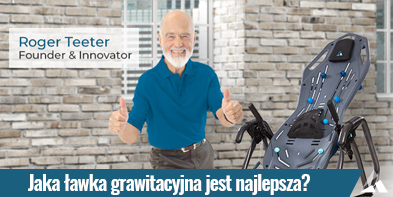
The company was founded in 1981 by Roger Teeter and his wife Jenny. Roger was an engineer who had previously worked on, among other things, designing and testing water skis. As he describes on the manufacturer's website, he developed back problems while testing equipment and struggled with them for several years. That is when he came across inversion, meaning a position in which the head is lower than the feet, and decided to make it his profession.
According to the manufacturer, the business started in a home garage. The first product was gravity boots, which Roger redesigned in his own way. From the very beginning the company was a family venture and - as teeter.com emphasizes - it remains a family-owned company to this day. We write more about the founder himself in the article Roger Teeter - the founder's story.
What are the most important milestones in Teeter's history?
Below we have compiled the dates and facts that the manufacturer provides in its materials. Where Teeter does not give an exact year, we describe the period in general terms.
| Period | What happened |
|---|---|
| 1981 | Roger and Jenny Teeter found the company. It starts in a garage with redesigned gravity boots. |
| 1982 | According to the manufacturer's materials, the company begins selling its first inversion table - the Over Easy model. |
| 1980s | More than forty manufacturers of inversion equipment are on the market. Teeter states that it is the only company from that period that has continuously developed inversion products to this day. |
| Late 1980s | Production moves from the garage to a facility in Washington State (USA). The products are known under the Hang Ups brand, later Teeter Hang Ups. |
| Late 1990s and the following years | According to the manufacturer, a marked increase in interest in inversion equipment worldwide. |
| 2008 | A Teeter table appears on the American TV show Good Morning America. |
| 2011 | Underwriters Laboratories updates the UL 1647 standard with requirements for inversion tables. Teeter announces that it is the first manufacturer to obtain a listing under the updated standard. |
| Following years | Teeter tables are registered with the US FDA as Class I medical devices, and in the European Union they carry the CE marking as medical devices. |
| Around 2020 | teeter.pl launches - the Polish store of the official distributor, with a Polish-language user manual. |
| Today | Headquarters in Bonney Lake (Washington State, USA); the range includes inversion tables, cardio machines, strength training equipment and recovery accessories. According to the manufacturer, more than 3 million people worldwide use Teeter tables. |
From gravity boots to the table - how have Teeter products evolved?
Gravity boots - the beginning
Gravity boots are strapped around the ankles and hooked onto a bar, and then you hang in full inversion. In the late 1970s and early 1980s they were very popular in the US - the manufacturer mentions that a 1980 movie contributed to their popularity, among other things. Their drawback, however, was how they were used: to hang, you need considerable arm and core strength, and there is only one angle - a full hang. Teeter gravity boots are still available today - in Poland as the Teeter EZ-Up XL. You can read more about them in the article gravity boots.
Inversion table - standing entry and angle control
The first table (1982) solved the main problem of the boots. On the table you stand with your back against the bed, secure your ankles, lie back and rotate by moving your arms. The table works without a motor - rotation is controlled by your body weight. You can stop at any angle and return upright without pulling yourself up on a bar. This design, refined over the following decades, is the foundation of all current Teeter tables. We explain exactly how it works in the guide how to use an inversion table.
ComforTrak and EP series
Subsequent generations of tables gained features that seem obvious today: roller hinges with several settings, an adjustable strap limiting the angle, more comfortable ankle supports and a foldable frame. A classic representative of this line is the Teeter EP-560 with the ComforTrak bed - a firm, flexible surface with "track" guidance along which the body glides smoothly during a session. You will find models from this series in the EP series inversion tables category.
FitSpine series
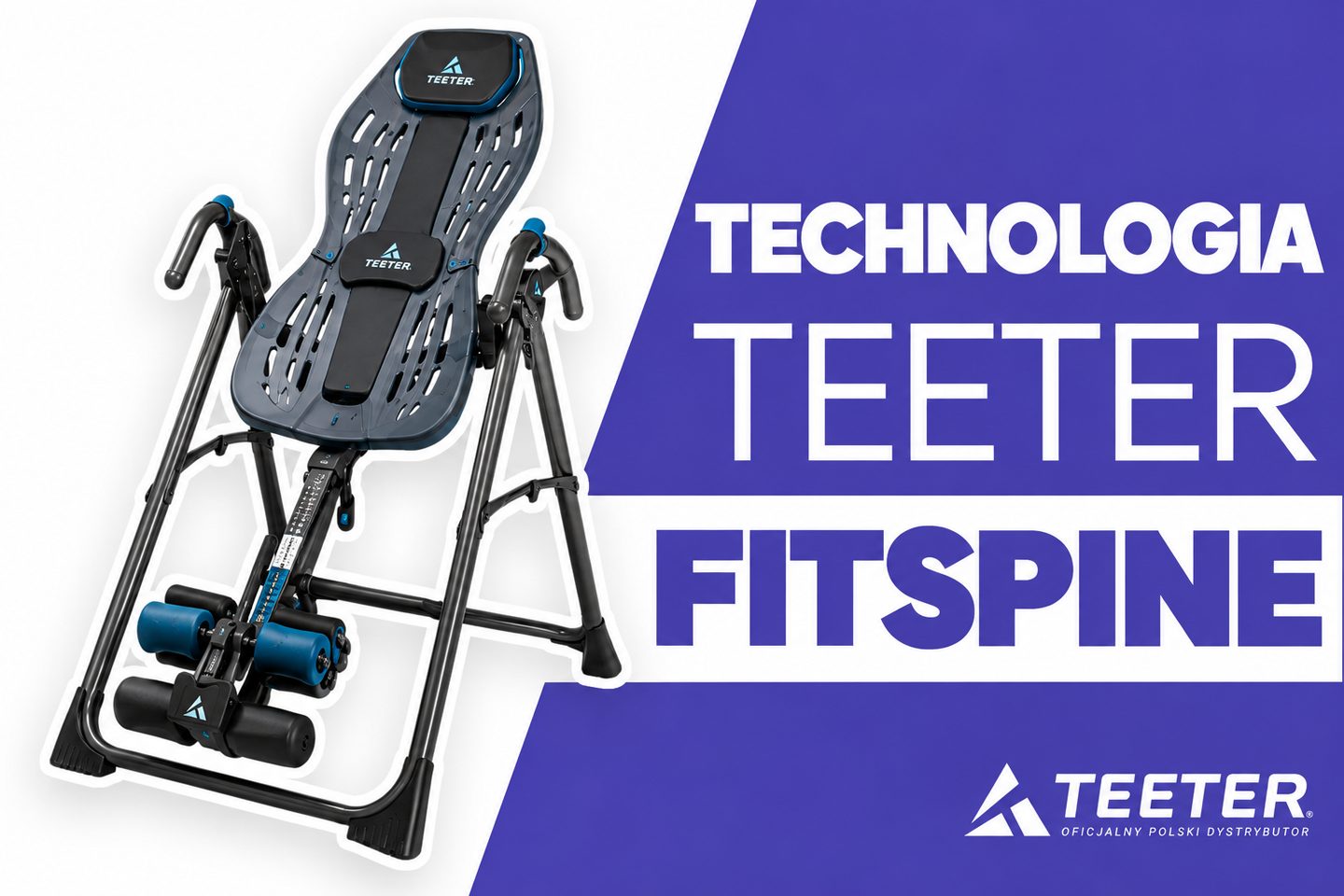
The newest line of tables is FitSpine. Its distinguishing feature is the FlexTech bed suspended at 8 points - it "floats" above the frame and flexes with the body during bends and twists. Higher-end models add the Deluxe EZ-Reach ankle lock with a long lever, an angle limiter marked at 20°, 40° and 60°, and extra stretch handles, and the LX9 also has an arched frame, a step-up platform and a storage caddy. In Poland we offer three models: FitSpine X1, FitSpine X3 and FitSpine LX9. We describe the differences between them in our FitSpine X1, X3 and LX9 comparison.
Beyond inversion - FreeStep, DEX II and accessories
Today Teeter is not just tables. The manufacturer also develops home exercise equipment: FreeStep cross trainers (a recumbent cross trainer with a seat), the DEX II bench, and self-massage and recovery accessories. Our range includes, among others, FreeStep trainers and the DEX II bench. These products are not medical devices - they are training equipment.
What is the UL 1647 standard and why does Teeter talk about it so often?
Underwriters Laboratories (UL) is an independent American organization that develops safety standards and certifies products. In 2011, UL updated the UL 1647 standard (massage and exercise machines), adding requirements specifically for inversion tables. According to the manufacturer, Roger Teeter had campaigned for years for such a standard for the entire industry.
The requirements include, among others, a 30,000-cycle rotation test at the maximum user weight, a strength test with a 4x safety margin relative to the permitted weight (for Teeter tables with a 136 kg limit, that is about 544 kg), an ankle lock test and factory inspections. We discuss this in detail in the article about the UL certificate. The manual for every table states that representative samples of the product have been evaluated by UL and meet the applicable safety standards.
Are Teeter tables medical devices?
Yes. The Teeter FitSpine X1, X3, LX9 and EP-560 tables are CE-marked medical devices (the EU representative is Medical Device Safety Service GmbH of Hannover). The manufacturer calls them decompression devices and defines their intended purpose as home spinal traction with simultaneous stretching of the paraspinal muscles and soft tissues, non-powered, for adults. In the US, Teeter tables are registered with the FDA as Class I medical devices. Registration is a formal fact - in the European Union, a product's status is determined by the CE marking.
This is a medical device. Use it in accordance with the instructions for use or the label. Consult your doctor before use - inversion has contraindications, which we describe in the article who an inversion table is for - contraindications.
How did Teeter come to Poland?
The official distributor of the Teeter brand in Poland is FLEXLIFE Sp. z o.o., which runs the teeter.pl store. The store has been operating since around 2020. From the start, one of our tasks was to prepare a Polish-language user manual - we translated it at our customers' request, because with an inversion table, understanding every warning and setting is extremely important.
What does buying from the official distributor mean in practice?
- Manual and support - we advise on choosing a model, assembly and setting up the table, by phone and e-mail.
- Warranty from the distributor - the manufacturer's warranty in the manual applies to customers in the USA and Canada, and outside those countries the terms are set by the local distributor. We provide a 5-year warranty on Teeter inversion tables.
- Shipping from Poland - free delivery, dispatch within 24 h and a 14-day return policy.
- Genuine parts and accessories - replacement acupressure nodes, mats and add-ons from the Teeter range. The manual prohibits using attachments other than Teeter ones on the table.
What remains of Teeter's history in today's tables?
Looking at the current models, it is easy to see traces of more than 40 years of development:
| Feature | Where it came from | Where you will find it today |
|---|---|---|
| Non-powered rotation controlled by arm movement | the first table from 1982 | all Teeter tables |
| Angle limiting with a strap | the need to get used to inversion gradually | Angle Tether (X1, EP-560), EZ-Angle 20/40/60° (X3, LX9) |
| Roller hinge with 3 settings | matching rotation speed to body weight | all tables in our range |
| Strength test with a 4x safety margin | UL 1647 standard (2011) | about 544 kg with a 136 kg limit |
| Flexible bed | ComforTrak, then FlexTech with 8-point suspension | EP-560 and the FitSpine series |
| Securing ankles without bending down | evolution of ankle locks | Deluxe EZ-Reach (X3, LX9) |
| Gravity boots | the first product from 1981 | Teeter EZ-Up XL |
All Teeter tables in our range have the same user range - 142-198 cm in height and up to 136 kg - full inversion with a lock, tool-free folding and assembly with the BILT app. If you are still choosing a model, take a look at the guide which inversion table is best or the inversion tables category.
Frequently asked questions
What year was Teeter founded?
In 1981. The company was founded by Roger Teeter and his wife Jenny, starting with redesigned gravity boots, and a year later they introduced their first inversion table.
Where is the Teeter brand from?
The USA. The company's headquarters is in Bonney Lake, Washington State. Teeter emphasizes that it has been a family-owned company from the start.
Are Teeter and Teeter Hang Ups the same company?
Yes. For years the products were sold under the Hang Ups brand, and later as Teeter Hang Ups. Today the manufacturer simply uses the name Teeter.
How many people use Teeter tables?
According to the manufacturer, more than 3 million people worldwide use Teeter tables.
Who is the Teeter distributor in Poland?
The official distributor is FLEXLIFE Sp. z o.o., which runs the teeter.pl store. We provide a manual, expert advice and a 5-year warranty on inversion tables.
Are Teeter tables FDA registered?
In the US, Teeter tables are registered with the FDA as Class I medical devices. This is a formal fact within the American system, not an assessment of effectiveness. In the European Union, medical device status is determined by the CE marking, which Teeter tables carry.
How does the FitSpine series differ from older Teeter tables?
Mainly in the bed: FitSpine has a FlexTech bed with 8-point suspension, while the EP-560 has the classic ComforTrak bed. Higher-end FitSpine models also have the Deluxe EZ-Reach lock, a 20/40/60° angle limiter and extra handles.
Does Teeter make anything besides inversion tables?
Yes. The range includes gravity boots, FreeStep trainers, the DEX II bench and self-massage accessories. These are not medical devices, but training equipment and accessories.
Recommended products
- Teeter FitSpine X3 - the most popular model in the FitSpine series, with the Deluxe EZ-Reach lock and a 20/40/60° angle limiter.
- Teeter EP-560 - a classic table with the ComforTrak bed, continuing Teeter's proven line.
- Teeter EZ-Up XL - gravity boots, a modern version of the product that started the brand's story.
- Teeter FreeStep LT3 - a seated cross trainer for cardio workouts at home.