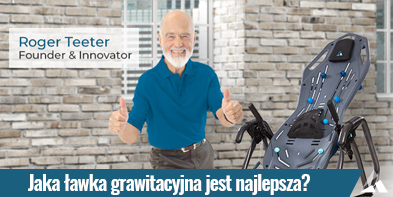
Behind every Teeter inversion table there is the name of a real person. Roger Teeter was an engineer and a passionate water skier who, in the early 1980s, decided to take on inversion equipment - first in his garage with his wife Jenny, and later in a company that now sells inversion tables all over the world. Who was he, where did the idea for the first table come from, and how does his approach to safety show in today's models? Below we profile the founder of Teeter based solely on information from the manufacturer (teeter.com and Teeter press materials) - no legends and no embellishing the story with details the company does not provide.
Who was Roger Teeter?
Roger Teeter was an American engineer and the co-founder of Teeter. According to the manufacturer's materials, he had experience in the aerospace industry and in designing water ski equipment. Water skiing was also his great passion - he competed in the sport and personally tested the skis he designed.
In 1981, together with his wife Jenny, he founded a company that started with gravity boots and a year later introduced its first inversion table. For years Roger was also the face of the brand - he appeared on TV shows presenting Teeter inversion tables, including on the American shopping channel HSN.
Where did the idea for the inversion table come from?
Back problems
On the manufacturer's website, Roger tells his story quite candidly. As a teenager he was in a serious car accident in which he injured his back. Later, in his thirties, while testing water skis he developed further back problems which - as he says himself - he struggled with for about five years. During that time, according to older accounts published by Teeter, he trained wearing a supportive back brace.
First encounter with inversion
Roger heard about inversion, a position in which your head is lower than your feet, from friends who used gravity boots. On the manufacturer's website he admits he was skeptical - he did not believe a few minutes upside down could matter when you spend well over ten hours a day upright. He tried it anyway, and this personal experience - as he has told many times - became the reason he founded the company.
It is worth saying clearly: Roger's story is his individual account, not a promise to anyone else. Every body is different, and inversion has contraindications. That is why this article does not describe health effects, only how an engineer's personal experience turned into a specific product.
How was the first Teeter inversion table created?
Teeter was founded in 1981 in a home garage. The first product was a pair of gravity boots that Roger redesigned his own way. Gravity boots have their limitations, though: to hang, you have to grab a bar and pull your legs up, and there is only one angle - a full vertical hang. For many people that is too big a challenge.
The answer was a table. According to the manufacturer's materials, in 1982 the company began selling its first inversion table - the Over Easy model. The idea was simple and still holds true today:
- you step onto the table standing up, with your back against the bed, and secure your ankles,
- you rotate without a motor by raising your arms overhead, which shifts your center of gravity,
- you can stop at a chosen angle instead of hanging fully vertical right away,
- you return upright by lowering your arms along your torso, without pulling yourself up.
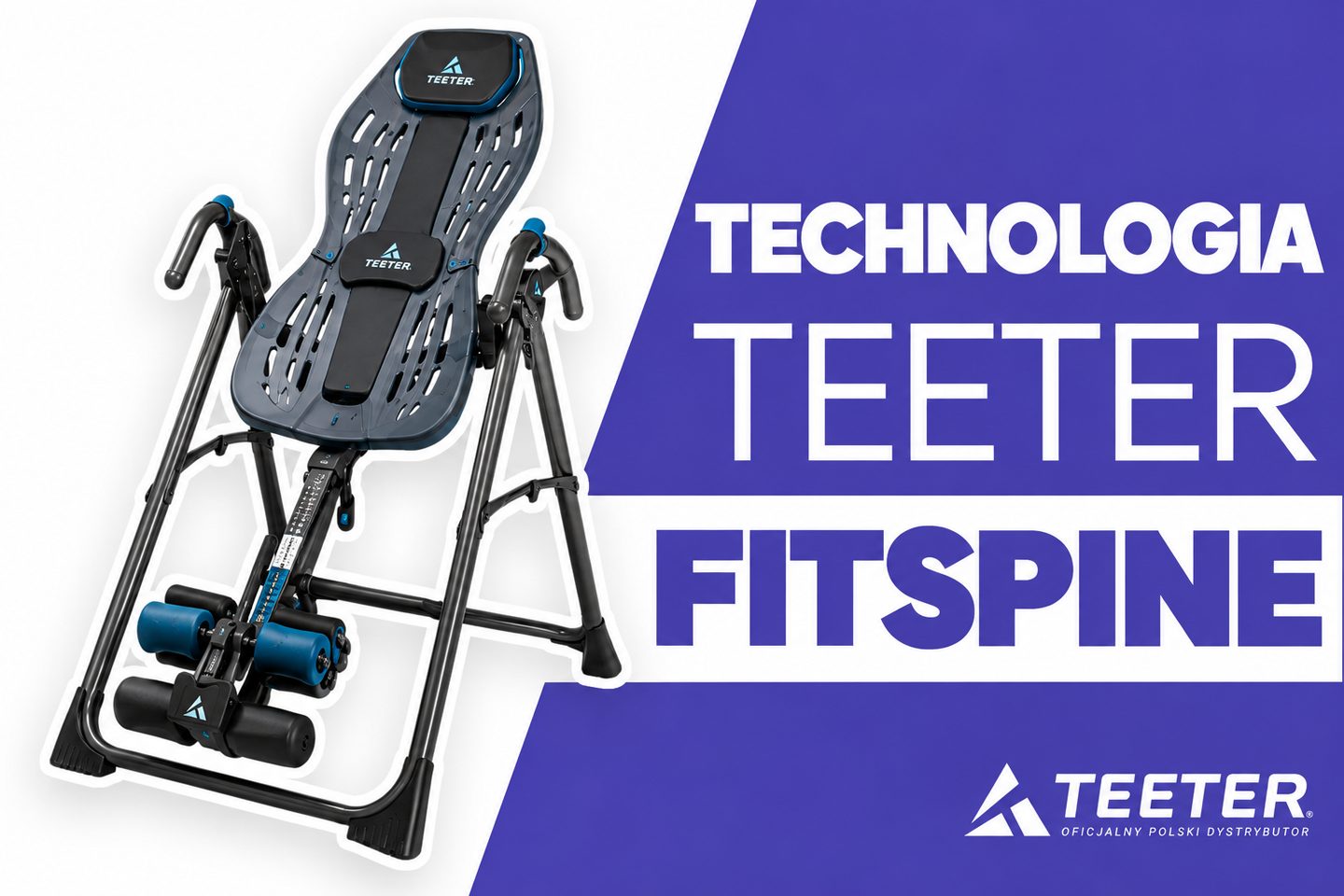
It is the same mechanism found in today's FitSpine X1, FitSpine X3, FitSpine LX9 and EP-560 tables - refined, of course, over more than forty years. We explain exactly how this system works in our guide how to use an inversion table.
How did Roger Teeter's company grow?
| Period | Milestone in Roger's life and the company |
|---|---|
| Youth | Car accident and back injury (according to Roger's account on teeter.com). |
| Before 1981 | Work as an engineer, designing and testing water skis, further back problems. |
| 1981 | Roger and Jenny start the company in their garage. First product: redesigned gravity boots. |
| 1982 | The first inversion table, the Over Easy. |
| Late 1980s | Move from the garage to a facility in Washington State. Products sold under the Hang Ups brand, later Teeter Hang Ups. |
| Following decades | Roger as the face of the brand on TV. According to the manufacturer, more than 100 product improvements, many of them patented. |
| 2011 | Updated UL 1647 safety standard for inversion tables. Teeter announces it is the first manufacturer to be listed under this standard. |
| Today | Teeter remains a family-owned company headquartered in Bonney Lake, Washington. |
Why did Roger Teeter put so much emphasis on safety?
An inversion table is a device on which you hang upside down, held only by your ankles. Any flaw in the design or setup has serious consequences here. According to the manufacturer, Roger spent about 30 years pushing for an independent safety standard for inversion tables in the industry. When Underwriters Laboratories updated the UL 1647 standard in 2011, Roger said in a Teeter statement that this was exactly the standard he had been advocating for years.
Among other things, the standard requires a 30,000-cycle rotation test at the maximum user weight, a strength test with a 4x safety margin over the rated weight (about 544 kg for a 136 kg limit) and an ankle lock test. You can see traces of this approach in every current table:
- Four user settings - the main shaft height, the roller hinge, the angle limiter and the Ankle Comfort Dial let you adjust the table to your height and weight.
- Angle limiter - a strap under the bed does not let you rotate further than you set it.
- The "hear it, feel it, see it, check it" method for securing your ankles, described in the manual.
- Detailed warnings and contraindications in the manual, including the requirement to get your doctor's approval before use.
What does Roger Teeter's company look like today?
From a garage, Teeter has grown into a brand present in many markets. According to the manufacturer, more than 3 million people worldwide use Teeter inversion tables. The headquarters is in Bonney Lake, Washington, and the company - as teeter.com emphasizes - remains family-owned. Today the lineup includes not only inversion tables but also cardio equipment such as FreeStep cross trainers, strength training equipment and recovery accessories.
The Teeter FitSpine X1, X3, LX9 and EP-560 tables are CE-marked medical devices intended for home spinal traction with simultaneous stretching of the paraspinal muscles and soft tissues. In the USA they are registered with the FDA as Class I medical devices. This is a medical device. Use it in accordance with the instructions for use or the label. Consult your doctor before use - we describe the contraindications in our article inversion table contraindications.
In Poland the brand is represented by its official distributor - FLEXLIFE Sp. z o.o., that is us, the teeter.pl store. We translated the user manual into Polish, we help you choose the right model and we offer a 5-year warranty on inversion tables. You will find all models in the inversion tables category.
What can you learn from Roger Teeter's story before buying an inversion table?
The founder's story offers a few practical takeaways for anyone considering an inversion table:
- Skepticism is fine. Roger himself approached inversion with caution. Do not buy a table based on promises - check its intended use, contraindications and manual.
- Start by talking to your doctor. One person's story says nothing about whether inversion is right for you.
- Prioritize structural safety. Look for verified testing and markings on the product itself.
- Start gradually. The Teeter manual recommends starting at a small angle of 20-30° with short, 1-2 minute sessions.
If you are wondering which model to choose, check out our guide which inversion table is best or our FitSpine X1, X3 and LX9 comparison.
How did Roger Teeter change the inversion equipment market?
In the early 1980s gravity boots were booming in the USA - the manufacturer mentions that a 1980 movie contributed to their popularity. According to Teeter, there were more than forty manufacturers of inversion equipment on the market at the time. Most of them disappeared once the trend faded. Teeter states that it is the only company from that era that has continuously developed inversion products to this day.
What, according to the manufacturer, set Roger's approach apart? Above all, an engineer's attention to details that users only notice during a session:
- Balance instead of strength - the table rotates by shifting your center of gravity, so you do not have to pull yourself up on a bar.
- Continuous improvement - according to Teeter's materials, the company has introduced more than 100 product improvements, many of them patented.
- User documentation - comprehensive manuals with settings, warnings and contraindications, which are now standard in Teeter documentation.
- Education - for years Roger personally presented the tables on TV, showing how to set up the equipment and how to safely return upright.
Which of Roger Teeter's ideas can you find in today's inversion tables?
| Idea from the company's history | What it looks like today |
|---|---|
| Gravity boots (1981) | Teeter EZ-Up XL boots for hanging from a bar - a training accessory |
| Table with stand-up entry (1982) | all Teeter tables; the LX9 also adds a raised entry platform |
| Motor-free rotation | arm movement control, main shaft adjustment and a roller hinge with 3 settings |
| Gradually getting used to inversion | angle limiter: Angle Tether or EZ-Angle with 20/40/60° markings |
| An industry safety standard | UL certification, test with a 4x safety margin (about 544 kg for a 136 kg limit) |
Frequently asked questions
Who founded Teeter?
Roger Teeter together with his wife Jenny. The company was founded in 1981 in a home garage in the USA.
What was Teeter's first product?
Gravity boots, which Roger redesigned in 1981. According to the manufacturer, the first inversion table, the Over Easy, came out in 1982.
Why did Roger Teeter get into inversion?
As he describes on the manufacturer's website, he struggled with back problems for several years after injuries and learned about inversion from friends who used gravity boots. This personal experience became the reason he founded the company. It is his individual story, not a promise of results for others.
Is the table named after the founder?
Yes. Teeter is the surname of the company's founder, Roger Teeter.
What is Teeter Hang Ups?
It is the brand's former name. For years Teeter products were sold under the Hang Ups brand, and later as Teeter Hang Ups. Today the manufacturer uses the name Teeter.
Where is Teeter located?
In Bonney Lake, Washington, USA. In Poland the official distributor is FLEXLIFE Sp. z o.o., which runs the teeter.pl store.
Is Teeter still a family business?
Yes, according to teeter.com, the company has remained family-owned from its garage beginnings to becoming a global brand.
Recommended products
- Teeter FitSpine X3 - our most popular model, with the Deluxe EZ-Reach ankle system and a 20/40/60° angle limiter.
- Teeter FitSpine LX9 - the flagship table with an arched LX frame, entry platform and storage caddy.
- Teeter EP-560 - a classic table with a ComforTrak bed.
- Teeter EZ-Up XL - gravity boots, the successor to the product Roger Teeter started with.