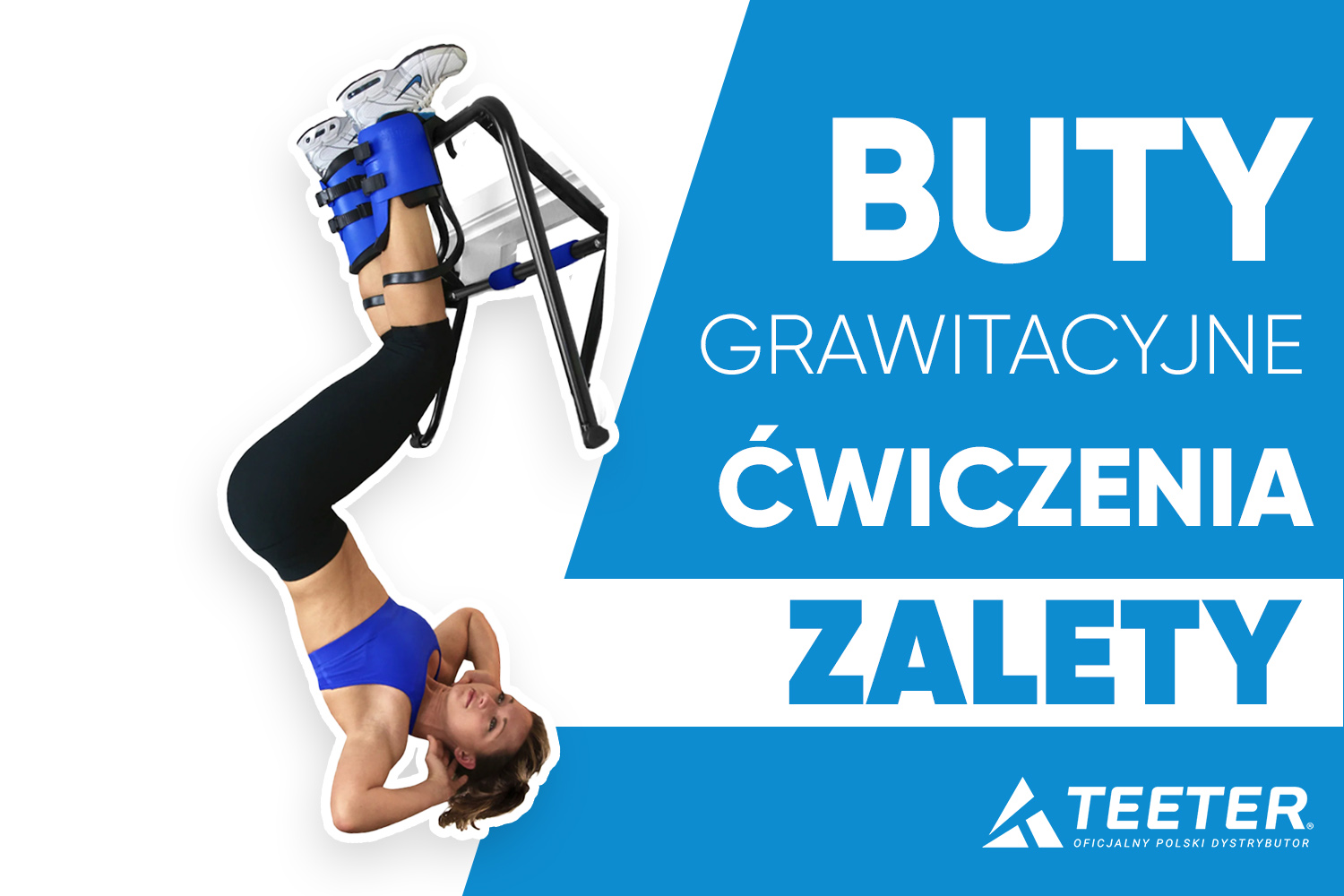
An inversion table looks simple - a frame, a rotating bed and an ankle lock - and yet it can smoothly rotate an adult head-down and back again without any motor. How is that possible? In this article we explain the mechanics of a Teeter inversion table: what balancing is about, what the roller hinge and its three settings are for, why you control rotation with arm movement, how the angle limiter, the ankle lock and the full-inversion lock work, and what returning upright looks like. We base this on the Teeter owner's manual and user guide. If you are looking for step-by-step instructions for your first session, see the guide how to use an inversion table - here we focus on why the table works the way it does.
What is a Teeter inversion table for?
The manufacturer calls Teeter tables decompression devices. The FitSpine X1, X3, LX9 and EP-560 tables are CE-marked medical devices intended for home spinal traction with simultaneous stretching of the paraspinal muscles and soft tissues. Traction is non-powered - its source is the weight of your body in the inverted position - and the devices are intended for adults, for home use.
This is a medical device. Use it in accordance with the instructions for use or the label. Before use you need to get a doctor's approval, because inversion has contraindications - we describe them in the article inversion table contraindications. In this text we deal solely with construction and mechanics.
What parts make up an inversion table?
Before we get to how it works, here is a quick map of the most important parts (names per the Teeter manual):
| Part | Function |
|---|---|
| A-frame | a stable base on which the whole table rotates; in the LX9, the curved LX frame |
| Table bed | the surface you lie on; ComforTrak in the EP-560, FlexTech in the FitSpine |
| Roller hinges with 3 holes | the bed's pivot axis; choosing a hole changes the speed and responsiveness of rotation |
| Height-adjustable main shaft | connects the bed to the ankle lock; its length is set to your height |
| Crossbar | the main shaft rests on it in the starting position, and the bed rests on it in full inversion |
| Angle limiter (tether) | a strap under the bed that stops it from rotating further than you set |
| Ankle lock system | holds your feet in the inverted position; T-pin or Deluxe EZ-Reach |
| Ankle Comfort Dial | a dial on the foot platform with a high and a low setting |
| Handles | help when getting on, stretching and returning |
What does balancing an inversion table involve?
The table works like a seesaw with its pivot in the roller hinges. On one side of the pivot is your upper body, on the other - your legs. When both "arms" are almost in balance, a small shift in mass distribution is enough to make the table start rotating. That is exactly why the table does not need a motor.
You set this balance with the length of the main shaft. The manual recommends starting with a setting about 2.54 cm (1 inch) greater than your height, e.g. 180 cm for a height of 178 cm. The ideal setting depends on your build and mass distribution, though, so it may differ by a few centimeters either way.
How do you check the balance?
The manual describes a simple test: lie on the table with your head on the bed and your arms at your sides.
- Correct - the table starts to rotate slightly and the main shaft lifts a few centimeters off the crossbar.
- Shaft too short - the table rotates strongly, to horizontal or beyond. Get off carefully and lengthen the setting by one hole.
- Shaft too long - the table does not move at all, the shaft rests on the crossbar. Get off and shorten the setting by one hole.
The manual warns that an incorrect setting can cause inverting too quickly or difficulty returning upright. The shaft setting stays valid until you change the roller hinge hole or your weight changes significantly.
What is the roller hinge and its 3 settings for?
The roller hinges are the points where the bed connects to the frame. They have three holes, and choosing one of them shifts the pivot point relative to the bed. The result: the speed and responsiveness of rotation change, i.e. how strongly the table reacts to arm movement.
- The choice of hole depends on body weight and how responsive you want rotation to be - the manual includes a weight chart for each setting.
- For people just learning to use the table, the manual recommends the "Beginner / partial inversion" setting.
- For full inversion with lock, setting A is used, and at a weight of 100 kg or more - setting B. The label on the table warns not to use setting A above 100 kg.
- The Teeter exercise guide indicates setting C for oscillation, i.e. rhythmic rocking.
Changing the hole requires removing the bed from the frame - the manual describes this step by step. After every change you need to test the balance again.
Why do you control the table with arm movement?
Since the table is balanced, the direction of rotation is decided by shifting the center of gravity. The easiest way to do that is with your arms:
- Arms overhead - mass shifts toward your head, the table rotates toward inversion.
- Arms along your torso - mass shifts back toward your legs, the table rotates toward upright.
- Bent knees - shift mass further toward your legs when arm movement alone is not enough.
The manual stresses a rule worth remembering: the faster you move, the faster the table rotates. That is why every movement should be slow and calm. To start, the manufacturer recommends raising one arm at a time and practicing control of speed and angle with slow arm movements forward and back.
How does the angle limiter work?
The limiter is a strap attached to a bar under the bed. When the table rotates to the set angle, the strap tightens and stops further rotation. This lets you work at a small angle without worrying that the table will "run away" to full inversion. Teeter tables use two solutions:
- Angle Tether (FitSpine X1, EP-560) - an adjustable strap with a buckle; by sliding the buckle you lengthen or shorten the range of rotation.
- EZ-Angle Tether (FitSpine X3, FitSpine LX9) - a strap with embroidered 20°, 40° and 60° markings, set in one move.
The manual recommends keeping the limiter attached for your first sessions until you find the right balance, and setting it to a small angle of 20-30° to start. With the strap detached, the table allows the full 90°. The limiter is also useful outside of sessions: by looping it around the main shaft and the crossbar you secure an unfolded table against accidental rotation.
How does the ankle lock work?
In the inverted position your entire body weight rests on your ankles, which is why the lock is the most important safety element. Your ankles go between the front and rear ankle cushions, and your feet rest on a platform with the Ankle Comfort Dial (high or low setting, a 2.54 cm difference). The dial is set so the cushions wrap the narrowest part of your ankles - this limits your body sliding along the bed, which would upset the balance.
| Lock type | Models | How it works |
|---|---|---|
| T-pin | FitSpine X1, EP-560 | a spring-loaded lock with a T-shaped handle, closed down at your feet |
| Deluxe EZ-Reach | FitSpine X3, LX9 | an extended lever and a micro-adjustable ratchet, an additional gravity-activated lock; you secure your feet without bending down and release with a blue button |
Regardless of type, the manual requires using the "hear, feel, see, check" method every time: the click, the cushions fitting snugly, no play, and a test by moving your feet. In addition, always wear securely laced shoes with flat soles - no thick soles and no shoes reaching above the ankle.
How does the table lock in full inversion?
Full inversion is rotation to 90° - you hang completely head-down and your back moves away from the bed. With the correct roller hinge setting (A, or B at a weight of 100 kg or more) the table rests against the crossbar, and your body weight holds it in this position until you start to return. The manual points out that if you tense up or press your back against the bed, the table may not "lock".
To come out of the lock, reach behind your head to the bed with one hand, grab the front of the frame with the other and pull your hands toward each other - taking care that your elbow does not end up between the bed and the frame. The manufacturer cautions not to attempt full inversion until you feel confident controlling rotation at 60°. Many users never go beyond 60°, and according to the manufacturer that is fine.
What does returning upright look like and why must you not sit up?
Returning reverses the rotation principle: you lower your arms along your torso and the center of gravity shifts toward your legs. During inversion your body may lengthen slightly or shift on the bed, so arm movement alone is sometimes not enough - then you bend your knees slightly.
The manual clearly prohibits lifting your head, relying only on the handles and trying to sit up. Sitting up while inverted is an abrupt movement that does not shift mass in the right direction and can catch you off guard with the rotation. After returning, it is worth pausing in the horizontal position for 15-30 seconds or longer before you get up. If you regularly have trouble returning, it is a signal to correct your user settings and repeat the balance test.
How do folding and securing the table work?
The folding mechanism uses the same parts as rotation. The manual describes it as follows:
- detach the angle limiter,
- extend the main shaft to the last hole (the storage setting, near the rear ankle cushions),
- stand in front of the bed and rotate it in the direction opposite to the direction of use until it rests against the frame crossbar,
- pull the spreader arms and fold the frame, leaving the legs spread approx. 40-50 cm apart for stability or securing the table against a wall.
When children are present, the table is stored folded, flat on the floor. If you leave it unfolded, secure it against accidental rotation - e.g. by looping the limiter strap around the main shaft and the crossbar and fastening it with the buckle.
How do you take care of the table's mechanism?
| When | What to do (per the Teeter manual) |
|---|---|
| Before every use | check that the table rotates smoothly to full inversion and back, that fasteners are secured and that there are no signs of wear |
| Before every use | check your user settings, especially when several people use the table |
| After changing the roller hinge | test balance and rotation control again |
| Cleaning | wipe the table with a damp cloth |
| Damage or wear | replace the part immediately with an original one and do not use the table until it is repaired |
| Missing or damaged label | contact customer service to receive a replacement label |
An inversion table mat will protect the floor under the table, and you will find spare parts and add-ons in the accessories section.
Frequently asked questions
Does an inversion table have a motor?
No. Teeter tables are non-powered - you control rotation with your body weight and arm movement, which is why they are also called gravity tables.
Why does the table rotate too fast?
Most often the main shaft is set too short or the movements are too quick. The manual recommends lengthening the shaft by one hole, checking the roller hinge setting and moving your arms slowly.
Why won't the table rotate?
The main shaft may be too long. Get off carefully, shorten the setting by one hole, secure your ankles again and repeat the balance test.
Which roller hinge setting should I choose to start?
The manual recommends the "Beginner / partial inversion" setting. The choice also depends on body weight - you will find the settings chart in the manual. Setting A is not used at a weight above 100 kg.
Can I use the table without the angle limiter?
Not at first. The manual recommends attaching the limiter for your first sessions and starting at 20-30°. You detach it only for full inversion, once you confidently control rotation at 60°.
How does the T-pin lock differ from the Deluxe EZ-Reach?
The T-pin is a spring-loaded lock with a T-handle closed down at your feet. The Deluxe EZ-Reach has a long lever and micro-adjustment, so you secure your feet without bending down. Both require checking with the "hear, feel, see, check" method.
Why must you not sit up when returning upright?
The manual prohibits it. The correct return is lowering your arms along your body and, if needed, slightly bending your knees, followed by a moment of rest in the horizontal position.
How many people can use one table?
The table is intended for multiple adult users, but each must check and set their four settings before use: the main shaft, the roller hinge, the angle limiter and the Ankle Comfort Dial.
Recommended products
- Teeter FitSpine X3 - the Deluxe EZ-Reach ankle lock and the EZ-Angle 20/40/60° limiter make angle control easier.
- Teeter FitSpine LX9 - everything the X3 has plus a curved frame and a step-up platform.
- Teeter FitSpine X1 - a FlexTech bed with a T-pin lock and an adjustable Angle Tether strap.
- Teeter EP-560 - a classic inversion table with a ComforTrak bed.