You are looking for a way to hang upside down at home and you find two completely different options: gravity boots (also called inversion boots or hang boots) that take up a fraction of the space, and an inversion table, which takes up part of a room but gives you full control over the angle. At first glance both do "the same thing." In practice they differ in almost everything: how you get into the inverted position, the equipment required, angle control, the amount of space needed, and also their status - a Teeter table is a medical device, while the boots are a training accessory. In this article we compare both options step by step, show a table of differences, suggest who each one is for, and discuss accessories worth adding to a table: a mat, acupressure nodes and the Core Restore cushion.
What are gravity boots (inversion boots)?
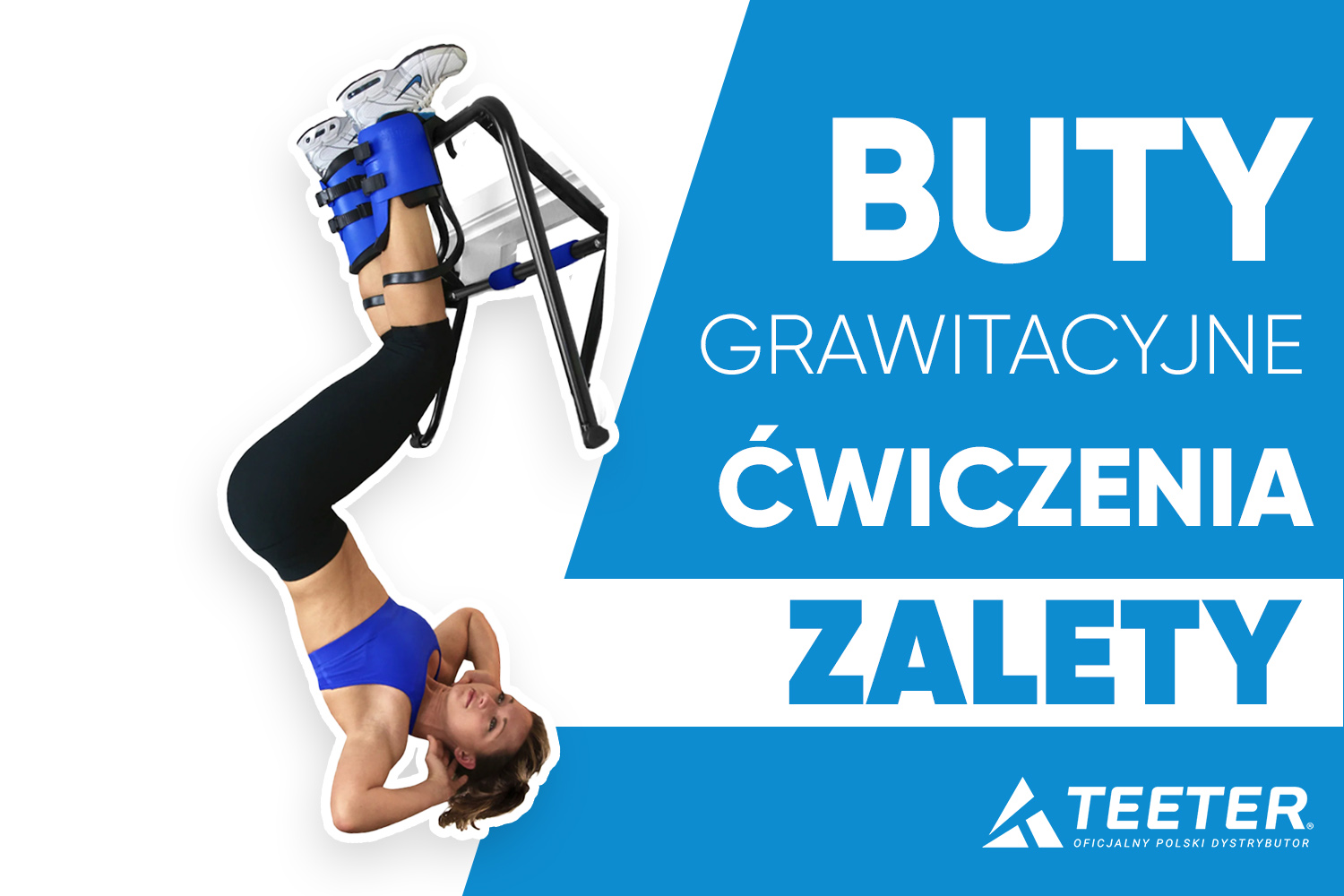
Gravity boots are an accessory for hanging from a bar. You put them on your ankles, hook the hooks on the boots over a bar - and hang upside down. In this position you can simply hang or do exercises such as crunches or torso twists. In our store you will find the Teeter EZ-Up XL model, and all boots in the Inversion boots category.
Online, the same products go by several names:
- gravity boots - the most popular name, from the gravity that "pulls" you while hanging,
- inversion boots - from inversion, meaning the upside-down position,
- hang boots or hanging boots - a descriptive name,
- anti-gravity boots - a common marketing variant.
Important: Teeter EZ-Up gravity boots are not a medical device. They are an accessory for training and hanging exercises - which is why we describe them only in terms of their design, how to use them and their training applications.
What is an inversion table?
An inversion table is a freestanding frame with a rotating bed. You stand with your back against the bed, lock your ankles, lie back and use arm movements to rotate to the chosen angle - from a slight tilt all the way to full inversion (90°). The Teeter tables we offer are the FitSpine X1, FitSpine X3, FitSpine LX9 and EP-560.
These tables are CE-marked medical devices. The manufacturer defines their intended purpose as home spinal traction with simultaneous stretching of the paraspinal muscles and soft tissues. This is a medical device. Use it in accordance with the instructions for use or the label. The table also has contraindications listed in the manual - you must consult a doctor before use.
Gravity boots or an inversion table - the key differences
Below we break the comparison down into five areas that decide the choice in practice.
1. Getting into the inverted position and back
Gravity boots: to hang, you have to grab the bar, lift your legs above your head and hook the boots onto the bar - and then reverse the steps to come back. This requires arm and core strength, fitness and coordination. There is no in-between stage: you are either standing or hanging vertically upside down.
Inversion table: you get on standing up, lock your ankles (on the X3 and LX9 with the Deluxe EZ-Reach lock with a long handle, without bending down), lie back and slowly rotate using arm movements. You return the same way, with arm movements and, if needed, by bending your knees. The manual recommends that new users have a second person assist them until they have mastered the settings.
2. Angle control
This is the most important functional difference. Gravity boots in practice give you one angle - a full hang (90°). An inversion table offers smooth adjustment: you control the angle with your arm movements, and the angle limiter does not let the table rotate further than you set it.
- On the X1 and EP-560 it is the adjustable Angle Tether strap with a buckle.
- On the X3 and LX9 it is the EZ-Angle Tether with stitched markings at 20°, 40° and 60°.
The table manual recommends starting at a moderate angle of 20-30° with short 1-2-minute sessions, then gradually progressing to 60°, with full inversion only for people who are in full control of rotation. Many users never go beyond 60°. With gravity boots, this "start with a small angle" path simply does not exist.
3. The bar and installation
Gravity boots need a bar - on their own they are only half the setup. The bar must be securely mounted and rated for your body weight while hanging and moving. So before buying boots, check:
- whether you have a bar, and if not - where and how you will mount it (wall, ceiling, door frame),
- what load the manufacturer of the bar and its mounting allows,
- whether there is enough space above and below the bar to hang without your head touching the floor,
- what the boots' manual says about bar compatibility and how to hook on.
An inversion table does not require any installation in a wall or ceiling. It is a freestanding structure you assemble out of the box with the included wrenches (with a free 3D guide in the BILT app), and after use you fold it without tools.
4. Space at home
The boots take up as much space as a pair of shoes - all the space is "taken" by the bar and the hanging zone below it. A table in use is over 2 m long and about 2.2 m high, and when folded it takes up about 51 x 73 cm of floor space (LX9: 56 x 81 cm).
| Table model | Dimensions in use | Folded dimensions | Table weight |
|---|---|---|---|
| EP-560 | 213.4 x 73.2 x 218.4 cm | 50.8 x 73.2 x 167.6 cm | 26.7 kg |
| FitSpine X1 | 205.7 x 73.2 x 219.7 cm | 50.8 x 73.2 x 167.6 cm | 27.4 kg |
| FitSpine X3 | 205.7 x 73.2 x 219.7 cm | 50.8 x 73.2 x 167.6 cm | 29.9 kg |
| FitSpine LX9 | 207.4 x 81.2 x 219.6 cm | 56.1 x 81.2 x 171.1 cm | 33.4 kg |
5. Who can use it
An inversion table has a clearly defined user range: 142-198 cm in height and up to 136 kg, adults only, for indoor home use. You adjust the settings (main shaft, roller hinges, angle limiter, Ankle Comfort Dial) to yourself, and in a household where several people use it, each person has their own.
Gravity boots are for physically fit people who can easily lift their legs to the bar and safely get down from it. Check the size range and maximum load in the EZ-Up XL product description.
Comparison table: gravity boots vs. inversion table
| Feature | EZ-Up gravity boots | Teeter inversion table |
|---|---|---|
| Status | training accessory (not a medical device) | CE-marked medical device |
| Additional equipment | requires a securely mounted bar | none needed - freestanding frame |
| Installation | mounting the bar (wall, ceiling, door frame) | assembling the table with the included wrenches, 3D guide in the BILT app |
| Angle | full vertical hang (90°) | smooth adjustment from 0° to 90° |
| Angle limit | none | Angle Tether / EZ-Angle 20/40/60° limiter |
| Getting into position | lifting your legs to the bar - requires strength and fitness | standing up, rotating with arm movements |
| Return | unhooking your legs from the bar while hanging | arm movements, bending the knees if needed |
| User range | according to the boots' and bar's manuals | 142-198 cm, up to 136 kg |
| Space | the zone below the bar | over 2 m long in use, about 51 x 73 cm of floor space when folded |
| Use | hanging and exercises while hanging (e.g. crunches) | spinal traction and stretching of the paraspinal muscles (intended purpose per the manufacturer), exercises and stretching on the table |
| Warranty in our store | per the product page | 5 years |
Who are gravity boots for, and who is an inversion table for?
Choose gravity boots if:
- you already have a sturdy bar or can mount one safely,
- you can easily lift your legs to the bar and get down from it in a controlled way,
- you are mainly interested in hanging workouts - crunches, twists, ab exercises,
- you have little space and do not want a freestanding structure at home.
Choose an inversion table if:
- you want to start at small angles and increase them gradually, as the manual describes,
- you value an angle limiter and smooth control of rotation,
- you do not want to or cannot mount a bar,
- several adults within the 142-198 cm and up to 136 kg range will use the device,
- you are looking for a device whose intended purpose according to the manufacturer is home spinal traction and stretching of the paraspinal muscles - and your doctor sees no contraindications.
Can gravity boots be combined with an inversion table?
Yes - and it is not an unusual combination at all. In Teeter's exercise guide, EZ-Up gravity boots appear in exercises at full inversion (90°) as additional ankle support, and the manufacturer shows some exercises (e.g. crunches) in a version with EZ-Up boots. Just remember the rule from the table's manual: only Teeter attachments may be used on the table, and full inversion is done only once you are in full control of rotation at 60°. Always check how to use the boots in their manual.
Which table to choose if you go with a table?
All Teeter tables we offer have the same user range, full inversion with a lock, a roller hinge with 3 settings, UL safety certification and a 5-year warranty. They differ in the bed, the ankle lock and extras.
| EP-560 | FitSpine X1 | FitSpine X3 | FitSpine LX9 | |
|---|---|---|---|---|
| Bed | ComforTrak | FlexTech + 8-point suspension | FlexTech + 8-point suspension | FlexTech + 8-point suspension |
| Ankle lock | T-pin | T-pin | Deluxe EZ-Reach | Deluxe EZ-Reach |
| Angle limiter | Angle Tether | Angle Tether | EZ-Angle 20/40/60° | EZ-Angle 20/40/60° |
| Stretch Max and EZ-Stretch handles | - | - | yes | yes |
| Frame | straight | straight | straight | curved LX |
| Platform and storage | - | - | - | yes |
In short: the EP-560 is the classic design with the ComforTrak bed (more models in the EP / FT series category), the X1 is the FlexTech bed in the basic configuration, the X3 is our most popular model with a lock you close without bending down, and the LX9 is the flagship with a curved frame, platform and storage. You can see all models in the Inversion tables category.
Which exercises can you do in boots, and which on a table?
The difference in angle control translates directly into what you can do. In gravity boots you are always in a full hang, so the repertoire is mainly exercises in a vertical upside-down position. On a table, the manufacturer's guide provides exercises at several levels - from small angles to full inversion. The overview below is based on Teeter's exercise guide and describes how to perform them, not a plan with promised results.
| Level (per the Teeter guide) | Angle | Example exercises on the table |
|---|---|---|
| Beginner | 30-45° | intermittent inversion (alternating 0° and 30-45°), overhead stretch, neck stretch, side arches, gentle torso rotation |
| Intermediate | 45-60° | oscillation (rhythmic rocking with the hinges in setting C), torso rotation, stretching with the handles, shoulder raises |
| Advanced | 60-90° | rotations, side stretches, single-leg squat |
| Full inversion - stretching | 90° | free hang, "corner" stretch (gripping a corner of the frame base), head rolls, bridge, hula hoop |
| Full inversion - exercises | 90° | front and side crunches, inverted squats, back stretch |
The guide advises starting each session at a smaller angle, focusing on deep breathing and not going beyond your comfort level. If any exercise or stretch causes pain, stop immediately and remove it from your routine. Full-inversion exercises are intended only for people who are in full control of the table's rotation.
Exercises in gravity boots
When hanging from a bar, the most common exercises are:
- hanging crunches - raising your torso toward your knees, with your arms crossed over your chest or loosely behind your head,
- side crunches - raising your torso alternately toward your left and right knee,
- free hang - simply hanging with your arms down, without sudden movements.
Exercise slowly and without swinging - sudden movements while hanging put stress on the bar and its mounting. Before your first attempts, ask someone to assist you when getting on and off the bar.
Stretching on a table at lower angles
A table offers extra options that boots do not: Grip-and-Stretch handles built into the bed and frame, and on the X3 and LX9 also Stretch Max handles and EZ-Stretch traction handles, which according to the manufacturer allow additional stretching at lower angles and rhythmic rocking. On top of that come the lumbar bridge and acupressure nodes, which according to the manual work best at moderate angles - in full inversion the body moves away from the bed.
Inversion table accessories - what is worth adding?
You do not need anything else to get started with a table - the set includes, among other things, a head pillow, a lumbar bridge and acupressure nodes. A few extras, however, make everyday use easier. You will find all of them in the Accessories category.
Inversion table mat
An inversion table mat protects the floor where the table stands. It is a simple extra worth laying down right after assembly.
Acupressure nodes
Acupressure nodes are part of the table's equipment: the set includes 4 pairs of varying firmness that you attach to the tracks in the bed and remove whenever you like. Additional or replacement nodes can be found in the Acupressure nodes category. Tips from the assembly manual:
- to attach a node, unscrew the black washer, slide the node into the slot from the back of the bed and screw it on - without excessive force,
- to change the position, loosen the washer and slide the node along the track,
- start with smaller nodes and move on to larger ones,
- the nodes work best at angles of 20-45°; in full inversion the body moves away from the bed,
- if you feel discomfort, reduce the pressure or stop using them.
Core Restore cushion
Teeter Core Restore is a lumbar cushion from Teeter - an accessory you use independently of the table. You will find details of its design and how to use it on the product page.
EZ-Up gravity boots
If you already have a table and want to expand your full-inversion exercises or train hanging from a bar, Teeter EZ-Up XL boots are an original Teeter accessory.
Safety - what to remember with each option?
Inversion table - the manual prohibits using the table without a doctor's approval and lists contraindications. The rules include the 142-198 cm and up to 136 kg range, no use by children, lace-up shoes with flat soles, checking the ankle lock with the "hear it - feel it - see it - check it" method, and starting at small angles with the limiter attached. If you experience pain, light-headedness or dizziness during inversion - return upright immediately.
Gravity boots - every time, check that the hooks hold securely on the bar and that the bar is firmly mounted. Follow the manuals for the boots and the bar, exercise without rushing, and ask someone to assist you during your first attempts. Before using an inverted position in any form, read the manufacturer's warnings and consult a doctor.
Frequently asked questions
What is the difference between gravity boots and inversion boots?
None - they are two names for the same accessory. You will also see the terms "hang boots," "hanging boots" and "anti-gravity boots." All of them mean boots worn on the ankles that you hook onto a bar to hang upside down.
Do gravity boots require a bar?
Yes. The boots on their own are only half the setup - you need a securely mounted bar rated for your body weight while hanging. Before buying, check the maximum load of the bar and its mounting, and whether there is enough space below the bar to hang freely.
Are gravity boots a medical device?
No. Teeter EZ-Up boots are a training accessory, not a medical device. The medical devices in our store are the FitSpine X1, X3, LX9 and EP-560 inversion tables.
Which is easier for a beginner: boots or a table?
A table gives you more control: you get on standing up, you increase the angle gradually, and the limiter does not let you rotate further than you set it. The manual recommends starting at 20-30° with 1-2-minute sessions. Boots mean a full hang right away and require strength to get on and off the bar.
Can you use gravity boots on an inversion table?
In Teeter's exercise guide, EZ-Up boots appear in full-inversion exercises as additional ankle support. The table manual allows only Teeter attachments on the table, and full inversion only after you have mastered rotation at 60°. Check how to use the boots in their manual.
How much space do you need for an inversion table, and how much for boots?
Boots need only a bar and a clear hanging zone below it. A table in use is 205.7 to 213.4 cm long and about 218-220 cm high, and when folded it takes up about 50.8 x 73.2 cm of floor space (LX9: 56.1 x 81.2 cm).
Can you set the angle on an inversion table?
Yes. You control the angle with your arm movements, and the limiter sets the maximum angle: on the X1 and EP-560 the adjustable Angle Tether strap, on the X3 and LX9 the EZ-Angle strap with markings at 20°, 40° and 60°. With the strap unhooked, full 90° inversion with a lock is possible.
What accessories should you buy for an inversion table?
To start, what is in the box is enough (pillow, lumbar bridge, 4 pairs of acupressure nodes). It is worth adding a table mat to protect the floor. Additional acupressure nodes, EZ-Up boots and the Core Restore cushion can be found in the Accessories category.
- Teeter EZ-Up XL - gravity boots for hanging and bar exercises.
- Teeter FitSpine X3 - a table with the Deluxe EZ-Reach lock and a 20/40/60° angle limiter.
- Teeter FitSpine X1 - a table with the FlexTech bed, a T-pin lock and an adjustable angle strap.
- Inversion table mat - protects the floor under the table.