You type "is it OK to hang upside down" into Google because you see people hanging from a bar in gravity boots, inversion tables in stores or inverted poses in yoga classes - and you wonder whether it is safe at all. The short answer is: many adults can spend time in an inverted position, but not everyone, and the way you do it matters a great deal. In this article we explain what happens to the body when your head is lower than your feet, who should not hang upside down (according to the Teeter inversion table manual), how long to hang upside down at first, what to do it on - an inversion table, gravity boots, a bar or a mat - and which signals mean you need to return upright immediately. No promises, just specifics from the manual.
Is it OK to hang upside down?
It is - provided you have no contraindications, use suitable equipment and start gradually. The inverted position is nothing exotic: it appears in gymnastics, in yoga classes (e.g. headstands or shoulder stands), in training with gravity boots, and at home - on inversion tables, also known as gravity tables. Teeter has been designing such tables since 1981, and according to the manufacturer more than 3 million people around the world use them.
At the same time, keep in mind that hanging upside down is not for everyone. The Teeter inversion table manual opens with a warning not to use the device without a doctor's approval and lists a number of conditions in which inversion is contraindicated. So instead of asking "is hanging upside down healthy", it is better to ask: "is it right for me and how do I do it sensibly?". We answer those two questions below.
What happens to the body when you hang upside down?
In the inverted position, the direction in which gravity acts changes. When you stand, your body weight loads the spine from above. When you are rotated head-down and secured by the ankles, your body is "stretched" in the opposite direction - this is the principle behind inversion tables, which the manufacturer calls decompression devices.
The inverted position also has obvious consequences, which the Teeter manual mentions: in this position blood pressure in the head rises, including pressure in the eyes and intracranial pressure. This is a normal response to a change in body position, but it is exactly why inversion is contraindicated in any condition that such an increase in pressure could aggravate. On their first attempts, many people also feel blood rushing to the face, a feeling of "fullness" in the head, and after returning upright - momentary dizziness if they stand up too quickly.
These sensations are one of the reasons the manual recommends starting at small angles instead of hanging vertically right away. Your body needs time to get used to the new position, and you need time to learn to control rotation.
Who should not hang upside down?
This is the most important part of this article. The Teeter inversion table manual is unequivocal: do not use the device until you have obtained your doctor's approval. Inversion is contraindicated in any condition that may be aggravated by increased blood pressure, increased intracranial pressure or the load associated with the inverted position. The manual lists, among others:
- neurological or other conditions that cause unexplained tingling, weakness, neuropathy, seizures, dizziness or disorientation;
- brain conditions, e.g. injury, previous intracranial bleeding, previous stroke or risk of stroke, severe headaches;
- heart and circulatory conditions, e.g. high blood pressure, hypertension, use of anticoagulants (including high doses of aspirin);
- bone, skeletal or spinal cord conditions or injuries, e.g. significant curvature of the spine, acute joint swelling, osteoporosis, fractures, dislocations, surgically implanted orthopedic supports;
- eye, ear or nose conditions or balance disorders, e.g. history of retinal detachment, glaucoma, ocular hypertension, chronic sinusitis, motion sickness;
- digestive or internal diseases, e.g. reflux, hiatal hernia or other hernia, gallbladder or kidney disease;
- conditions in which exercise is restricted or prohibited by a doctor, e.g. pregnancy, obesity, recent surgery.
This is not a complete list - the content of the manual supplied with the specific device always applies. The manual also prohibits use of the table by children and by people under the influence of alcohol, drugs or medication causing drowsiness or disorientation. The table is not intended for people with reduced physical, sensory or mental capabilities unless they use it under the supervision of a person responsible for their safety. We discuss this topic in detail in the article who an inversion table is right for - contraindications.
If you are not sure whether any of these points applies to you, do not experiment on your own. Talk to your doctor before you try any form of hanging upside down - on a table, on a bar or on a mat.
How long can you hang upside down?
There is no single number that fits everyone and every piece of equipment. The most specific guidance comes from the Teeter inversion table manual and the manufacturer's exercise guide. They address three things: time, angle and frequency.
Session time
The manual recommends starting with short, 1-2-minute sessions so that your body can adapt to inversion. Over time, once you feel comfortable, you can gradually extend the time - according to the manufacturer, the target is usually about 3-5 minutes. There is no need for sessions to be longer.
Angle
On a table you do not have to hang vertically right away. The manual recommends staying at a small angle of 20-30° for the first weeks and introducing larger angles only when you can fully relax. The next stage is an angle of up to 60°, at which your legs are roughly parallel to the rear legs of the frame. The manufacturer stresses that many users never go beyond 60°, and that is fine. Full inversion (90°) is an option for people who confidently control rotation at 60°.
Frequency
According to the manufacturer, shorter, more frequent sessions are a better choice than long sessions done rarely. Frequency matters more than duration. Remember that this is the method of use described in the manual, not a promise of results.
| Stage (per the Teeter manual and guide) | Angle | Session time | What to watch for |
|---|---|---|---|
| First sessions | 20-30° | 1-2 min | angle limiter attached, a second person nearby, learning to control rotation with arm movement |
| Following weeks | 30-45° | gradually up to 3-5 min | full relaxation, calm breathing, intermittent inversion (alternating 0° and a small angle) |
| Intermediate | 45-60° | 3-5 min | slow movements, gentle stretching using the handles |
| Full inversion | 90° | 3-5 min | only with confident rotation control at 60°, limiter detached, correct roller hinge setting |
| After every session | 0° (horizontal) | 15-30 s or longer | rest in the horizontal position before returning upright |
With gravity boots the situation is different - there is no "small angle" stage, because you hang vertically right away. Always check the hanging time and method of use in the instructions for the boots and the bar. A sensible rule is to start with a very short hang and have a second person assist you on your first attempts.
What to hang upside down on? Table, boots, bar, yoga
There are several ways to get into an inverted position, and they differ mainly in angle control, the way you get in and out, and the physical fitness they require.
Inversion table (gravity table)
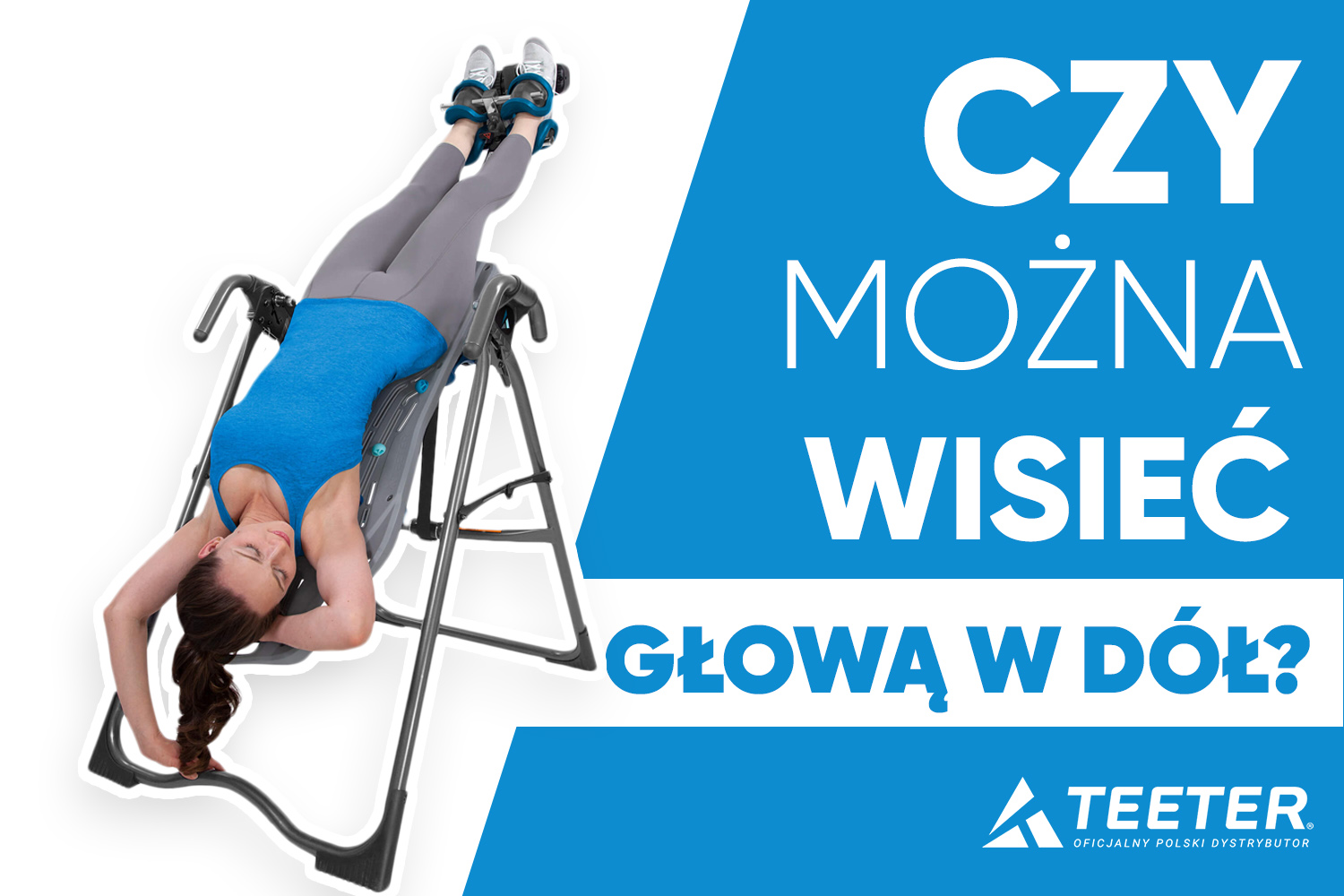
An inversion table is a freestanding frame with a rotating bed. You stand with your back to the bed, secure your ankles in the lock, lie back and slowly rotate using arm movement. You control movement with your own body weight: arms overhead - the table rotates toward inversion, arms along your torso - it returns toward upright. The angle limiter (a strap under the bed) stops it from rotating further than you set. This lets you start at 20° and increase the angle gradually, as the manual describes.
The Teeter FitSpine X1, X3, LX9 and EP-560 inversion tables are CE-marked medical devices intended for home spinal traction with simultaneous stretching of the paraspinal muscles and soft tissues. They are intended for adults from 142 to 198 cm tall and weighing up to 136 kg.
This is a medical device. Use it in accordance with the instructions for use or the label.
Gravity boots and a bar
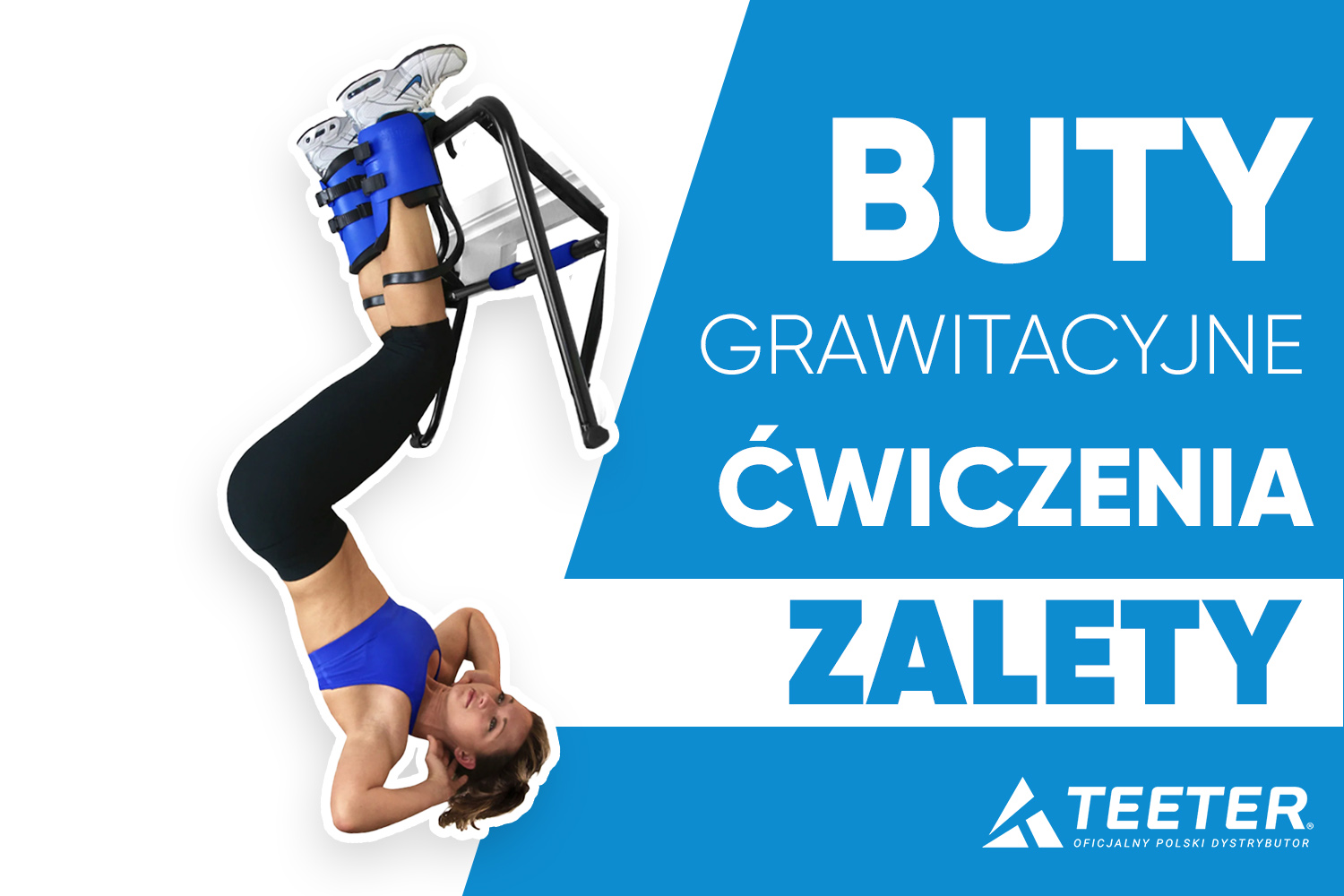
Gravity (inversion) boots are worn around the ankles and hooked onto a bar. To hang, you have to grab the bar, lift your legs and hook the boots on - and then get down in reverse order. This requires arm and core strength and good coordination. In practice there is only one angle: a full hang. The bar must be securely mounted and rated for your body weight. Teeter EZ-Up XL Gravity Boots are not a medical device - they are an accessory for hanging training. Read more about the differences in the article gravity boots.
Hanging from a bar without boots
An ordinary hang from a bar by your hands is a completely different position - your head is above your feet, so it is not inversion. Attempts to hang upside down from a bar by your knees (like on a playground bar) have no safety mechanism or angle control, and if your legs slip you risk falling on your head. We do not recommend this as a way to get into an inverted position at home.
Inverted poses in yoga
Headstands, shoulder stands and handstands are positions in which your head is lower than your legs, but your body weight rests on your head, neck, shoulders or hands. They require preparation, strength and technique, and in the case of a headstand - a heavy load on the cervical spine. They are best learned under the guidance of an experienced instructor. The same contraindications that apply to inversion on a table are worth discussing with a doctor before inverted yoga poses as well.
| Method | Angle control | Getting in and returning | Requirements |
|---|---|---|---|
| Inversion table | smooth adjustment from 0° to 90°, angle limiter | standing, rotation with arm movement | adults 142-198 cm, up to 136 kg, doctor's approval, user settings |
| Gravity boots + bar | none, full hang | pulling your legs up to the bar | strength, fitness, a sturdy bar, boot instructions |
| Hanging by the knees (playground bar) | none | no safety mechanism | not recommended at home |
| Inverted yoga poses | depends on the pose | on your own, requires technique | preparation, learning with an instructor |
How to safely start hanging upside down on a table?
Below is a summary of the procedure from the Teeter inversion table manual. You will find a full step-by-step description in the guide how to use an inversion table.
1. Prepare the table and yourself
- Read the entire manual and check the table before every use - all fasteners must be secured and the bed must rotate smoothly.
- Set the four user settings: main shaft height (initially about 2.5 cm more than your height), roller hinge hole, angle limiter and Ankle Comfort Dial.
- Wear securely laced shoes with flat soles, e.g. sneakers. Do not wear shoes with thick soles.
- Make sure there is enough room in front of you, above you and behind you for rotation, and that children and pets are away from the table.
- For your first sessions, ask a second person to stay nearby.
2. Secure your ankles
The manual recommends the "hear, feel, see, check" method: you hear the lock click, you feel the cushions fit snugly against your legs, you see that the lock is closed and there is no gap between your ankles and the cushions, and you check, by moving your feet, that they cannot be pulled out.
3. Check the balance
Lie flat with your head on the pillow and your arms at your sides. With the correct setting, the table should start to rotate slightly. If it rotates too strongly, the main shaft may be set too low; if it does not move at all - too high. In that case, get off carefully and adjust the setting by one hole.
4. Rotate slowly
Raise one arm, then the other, to start rotating. The slower you move, the slower the table rotates. Once you reach the set angle, relax and breathe calmly.
5. Return upright the right way
Lower your arms along your torso. If that is not enough, bend your knees slightly. Do not lift your head and do not try to sit up - this is one of the most important warnings in the manual. After returning, pause in the horizontal position for 15-30 seconds or longer, and only then return upright and get off the table.
When should you stop hanging upside down immediately?
The Teeter manual says it plainly: if you feel pain or dizziness while inverting, return to the starting position immediately. Also stop the session if you experience:
- strong pressure in the head, a headache or a bursting sensation in the eyes,
- nausea, visual disturbances, spots before your eyes,
- numbness, tingling or weakness,
- pain or discomfort in the ankles that adjusting the lock does not relieve,
- anxiety, panic or a feeling that you are losing control of the rotation.
The manual recommends "listening to your body": if you feel discomfort, reduce the angle or session time, try at a different time of day or stop for today. If worrying symptoms recur or do not go away after returning upright, contact a doctor and do not return to inversion without their approval.
The most common mistakes when hanging upside down
- Going straight to full inversion. The manual recommends starting at 20-30°, and full inversion only with confident rotation control at 60°.
- First sessions that are too long. 1-2 minutes is enough to start.
- No angle limiter. Without the strap, the table may rotate further than you want.
- Incorrect settings. A wrongly set main shaft can cause rotation that is too fast or difficulty returning.
- Unsuitable footwear. Slippers, bare feet or shoes with thick soles make it hard to secure the ankles properly.
- Sitting up when returning. Instead of sitting up, lower your arms and bend your knees.
- Abrupt movements, weights and resistance bands. The manual prohibits aggressive movements and using weights or other exercise equipment on the table.
- Standing up quickly. After a session, rest for a moment in the horizontal position.
Which table should you choose for inversion at home?
All Teeter inversion tables we offer have the same user range (142-198 cm, up to 136 kg), full inversion with lock, a roller hinge with 3 settings, tool-free folding, UL safety certification and a 5-year warranty. They differ in the bed, ankle lock and extras.
- Teeter EP-560 - a classic table with a ComforTrak bed, a T-pin lock and an adjustable Angle Tether strap.
- Teeter FitSpine X1 - a FlexTech bed with 8-point suspension and a T-pin lock.
- Teeter FitSpine X3 - the Deluxe EZ-Reach lock you fasten without bending down and an angle limiter with 20°, 40° and 60° markings, which makes it easier to follow the small-angle recommendations.
- Teeter FitSpine LX9 - everything the X3 has, plus a curved LX frame, a step-up platform and a storage caddy.
If you are still choosing a model, see the guide which inversion table is best or the FitSpine X1, X3 and LX9 comparison. You will find all models in the inversion tables category, and an inversion table mat will protect the floor under the table.
Frequently asked questions
Is hanging upside down safe?
Many adults without contraindications use the inverted position, doing it on suitable equipment, according to the manual and gradually. However, it is not for everyone. The Teeter inversion table manual requires a doctor's approval before use and lists contraindications, including hypertension, glaucoma, osteoporosis, hernias, pregnancy and a previous stroke.
How long can you hang upside down the first time?
The Teeter manual recommends 1-2 minutes at a small angle of 20-30°. The time is extended gradually once you feel comfortable, usually up to about 3-5 minutes per session.
Do you have to hang vertically right away?
No. On an inversion table you can stay at small angles. The manufacturer stresses that many users never go beyond 60°. Full inversion (90°) is an option for people who confidently control rotation.
Why does your face turn red when you hang upside down?
In the inverted position, blood flows toward the head and pressure in the head rises. This is a typical sensation, but if it is accompanied by a headache, dizziness, nausea or visual disturbances, return upright immediately.
Can you feel dizzy after hanging upside down?
It can happen if you return upright too quickly. That is why the manual recommends resting in the horizontal position for 15-30 seconds or longer. If dizziness occurs during inversion, stop the session. If it recurs, consult a doctor.
Which is better: an inversion table or gravity boots?
It depends on your goal and fitness. A table gives you angle adjustment, a limiter and getting on while standing. Boots require a bar and strength, and there is only one angle - a full hang. Teeter inversion tables are medical devices, while EZ-Up boots are a training accessory.
Can children hang upside down on an inversion table?
No. The Teeter manual prohibits use of the table by children and recommends keeping children away from the device while it is in use. The table must not be stored in a room children can access unsupervised.
How many times a day can you hang upside down?
According to the manufacturer, shorter, more frequent sessions work better than long, infrequent ones. The Teeter exercise guide gives 2 sessions a day at the beginner level and 1-2 sessions a day at higher levels. Always adjust this to how you feel and to your doctor's recommendations.
Recommended products
- Teeter FitSpine X3 - the most popular model, with a 20/40/60° angle limiter and the Deluxe EZ-Reach lock.
- Teeter FitSpine LX9 - the flagship table with a curved frame, a step-up platform and a storage caddy.
- Teeter EP-560 - a classic table with a ComforTrak bed and an adjustable angle strap.
- Teeter EZ-Up XL Gravity Boots - gravity boots for hanging from a bar, a training accessory.