A mat rolled up behind the couch, equipment crammed into a closet and rearranging the furniture before every workout - that's what a "home gym" looks like in many apartments. The result is easy to predict: the more preparation it takes, the less often we exercise. A well-planned exercise and stretching corner doesn't require a separate room. All you need is a well-thought-out spot, the right floor, equipment chosen to fit your space and a simple way to store it. In this step-by-step guide we show you how to plan it: how much space Teeter equipment needs, which mat to choose, how to store folding equipment safely, where an inversion table, a FreeStep trainer and self-massage accessories fit in, and how to put together a simple week of activity. This text is about setting up a space and using equipment according to the manufacturer's instructions - it is not medical advice.
How to set up a home workout corner?
Before you buy anything, answer three questions: where you will exercise, what you want to do there (cardio, stretching on a mat, using an inversion table) and whether the equipment will stay set up permanently or be put away after each session. Everything else depends on these answers - from the choice of mat to the equipment model.
Choosing the spot - what to look for
- A level, stable floor. The manuals for the inversion tables and the FreeStep trainer require the equipment to be placed on a level surface, away from water and edges that could cause a fall - e.g. stairs or a patio step.
- Clear space around the equipment. Not only for the equipment itself, but also for getting on, getting off and moving during exercise. We give specific dimensions below.
- Ceiling height. With an inversion table, what matters is what is above you - the FitSpine manual tells you to make sure there is enough space in front of, above and behind the user to rotate. A chandelier or low-hanging lamp is a common problem in living rooms.
- Light and airflow. A window or good ventilation makes you want to come back to the corner.
- Line of sight. Equipment you see every day is easier to work into your routine than equipment hidden in a basement or garage. Garages and balconies are also ruled out for another reason - Teeter manuals call for indoor use and storage only.
- Children and pets. The manuals for the tables and FreeStep prohibit children from using the equipment and say to keep children and pets away from it during exercise. If you have small children at home, choose a room that can be closed off.
Zones in your workout corner
Even in a few square meters, it pays to think of the corner as three zones:
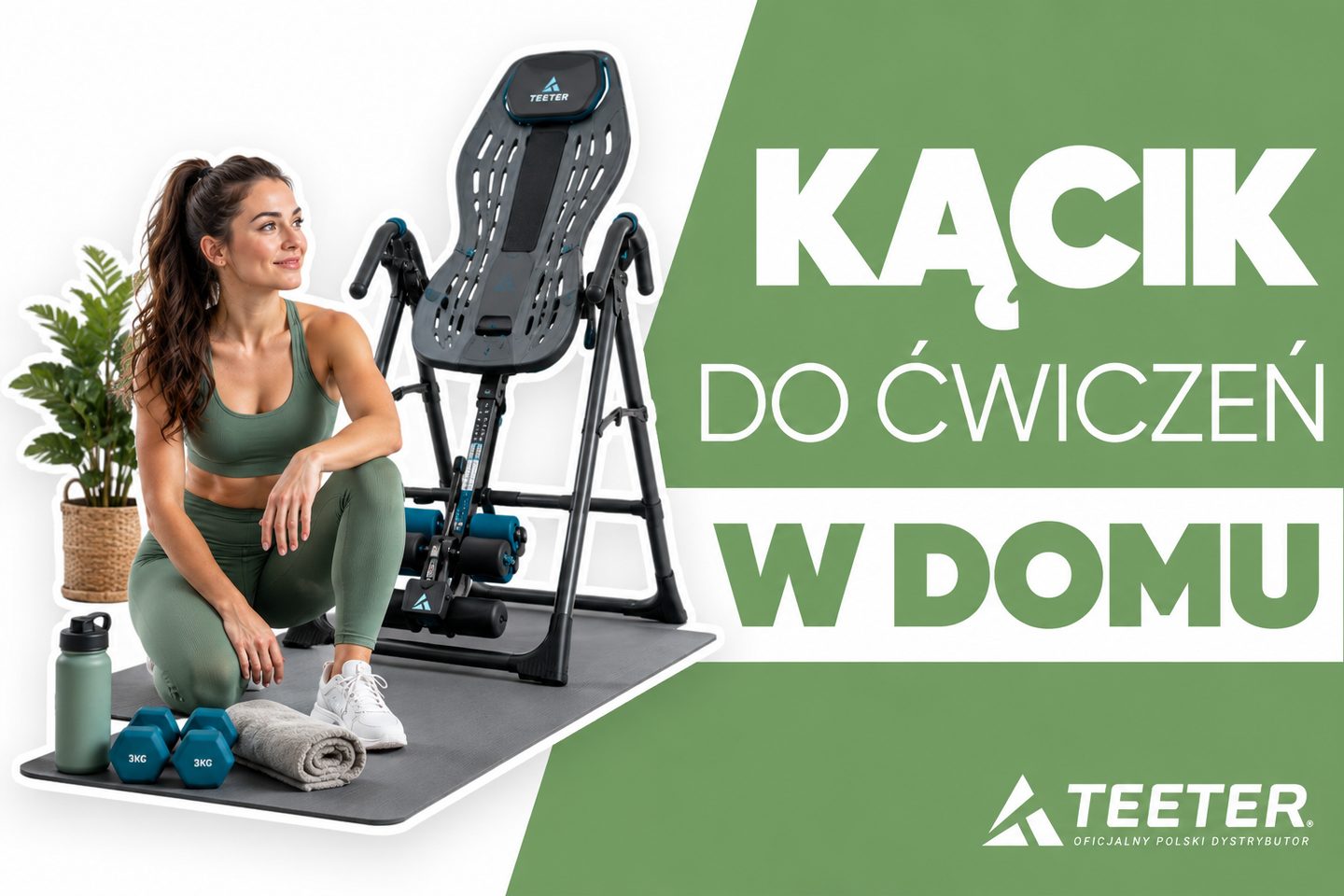
- Equipment zone - space for the inversion table or trainer, with the clearance required by the manual.
- Mat zone - a patch of floor for stretching, floor exercises and self-massage accessories.
- Storage zone - a container, shelf or basket for small accessories, workout shoes, a water bottle and your phone.
The zones can overlap - the mat can lie where the folded table stands after a workout, and the FreeStep trainer can be rolled on its wheels to the wall. What matters is that nothing is in the equipment's range of motion during exercise.
How much space do you need for a small-space home gym?
This is the question we hear most often. Below we have gathered the dimensions of Teeter equipment according to the manufacturer's data. The "in use" dimension is the maximum size of the unfolded equipment - for an inversion table it includes rotation into the inverted position.
| Equipment | Dimensions in use (L x W x H) | Folded | Equipment weight |
|---|---|---|---|
| Teeter EP-560 | 213.4 x 73.2 x 218.4 cm | 50.8 x 73.2 x 167.6 cm | 26.7 kg |
| Teeter FitSpine X1 | 205.7 x 73.2 x 219.7 cm | 50.8 x 73.2 x 167.6 cm | 27.4 kg |
| Teeter FitSpine X3 | 205.7 x 73.2 x 219.7 cm | 50.8 x 73.2 x 167.6 cm | 29.9 kg |
| Teeter FitSpine LX9 | 207.4 x 81.2 x 219.6 cm | 56.1 x 81.2 x 171.1 cm | 33.4 kg |
| Teeter FreeStep LT1 / LT3 | 157.6 x approx. 83 x 140.6 cm (width in the manual: 96.5 cm) | does not fold - rolls on wheels | 48.5 / 50.0 kg |
How do you convert this into square meters?
Add a clearance zone to the equipment dimensions:
- Inversion table - in use it takes up about 2.1 m in length and 0.7-0.8 m in width, and during rotation it reaches about 2.2 m in height. Add space at the side for getting on and off, plus some room in front of and behind the table. In practice it is worth reserving a rectangle of about 2.5 x 1.5 m and checking that nothing hangs above the table.
- FreeStep trainer - the manual requires that there be no objects within 61 cm around the equipment. Including this zone, that comes to about 2.8 x 2.2 m during a workout. After exercising you can roll it closer to the wall.
- Stretching mat - a typical mat is about as long as an adult is tall, and some extra room around it is useful for stretched-out arms and legs.
This means a small-space home gym is entirely possible - you can fit an inversion table and a mat into part of a living room or bedroom, as long as you clear the required space during exercise and fold or put the equipment away afterward.
Which floor and exercise mat for home workouts?
The floor in your workout corner has two jobs: to provide stable support for the equipment and to protect the floor surface itself. Laminate, hardwood and tiles stand up well to daily use, but table feet or trainer wheels can leave marks, and equipment moving on a slippery surface is not desirable.
Equipment mat
The simplest option under an inversion table is a dedicated Teeter inversion table mat - it protects the floor under the equipment and marks its place in the room. Under a FreeStep trainer, a protective fitness equipment mat works well. The FreeStep manual notes that you should be careful with delicate floors, e.g. wood, when rolling the equipment on its wheels.
Exercise and stretching mat
For floor exercises, a separate mat is useful - long enough to lie on and thick enough to kneel or lie on your side comfortably. When choosing one, pay attention to:
- A non-slip base - the mat must not slide on laminate floors.
- Easy cleaning - a surface you can wipe with a damp cloth.
- How it is stored - a roll-up mat can stand in a corner or hang on a hook, a folding one can go under the bed.
Leveling feet and uneven floors
The FreeStep trainer has two leveling feet. If the equipment wobbles after you set it up, simply unscrew the feet until both rest on the floor - that is how the manual describes it. Always place an inversion table on a level surface; if the floor in a given spot is clearly uneven, it is better to choose another place in the room.
Which stretching and exercise equipment should you choose for home?
The Teeter range includes equipment from three groups. Each has a different purpose and each needs to be planned differently in your corner.
| Equipment | What it is for | Is it a medical device | Place in the corner |
|---|---|---|---|
| Inversion tables FitSpine X1, X3, LX9, EP-560 | home spinal traction with stretching of the paraspinal muscles (per intended use) | yes | equipment zone, folded against the wall or flat on the floor |
| FreeStep LT1 and LT3 trainers | seated cardio training, working arms and legs | no | equipment zone, rolls on wheels |
| Self-massage and stretching accessories | self-massage, mat exercises | no | container or shelf in the storage zone |
Where does an inversion table fit in?
The Teeter FitSpine X1, X3, LX9 and EP-560 inversion tables are medical devices for home spinal traction with simultaneous stretching of the paraspinal muscles and soft tissues. They work on the principle of decompression by inversion - with ankles secured, the user reclines on the bed at a chosen angle. This is a medical device. Use it in accordance with the instructions for use or the label.
Before first use, the manual requires a doctor's approval. Inversion is contraindicated in conditions including heart and circulatory disorders (e.g. high blood pressure, use of anticoagulants), brain injuries, neurological conditions causing dizziness or disorientation, osteoporosis, fractures, surgically implanted orthopedic supports, eye diseases (e.g. glaucoma, retinal detachment) and ear diseases, and during pregnancy - you will find the full list in the manual supplied with the table. The tables are intended for adults 142-198 cm tall and weighing up to 136 kg, for indoor home use only.
When planning a spot for the table in your corner, keep a few rules from the manual in mind:
- Room to rotate - there must be clear space in front of, above and behind you. During rotation the table reaches about 2.2 m in height.
- Shoes at hand - lace-up shoes with flat soles, e.g. sneakers, are worn on the table. Keep them in the storage zone next to the table so you aren't tempted to use it in slippers.
- A companion - for the first sessions and when setting the balance, the manual recommends help from a second person.
- No extra load - no weights, resistance bands or other exercise equipment from outside the Teeter range are used on the table.
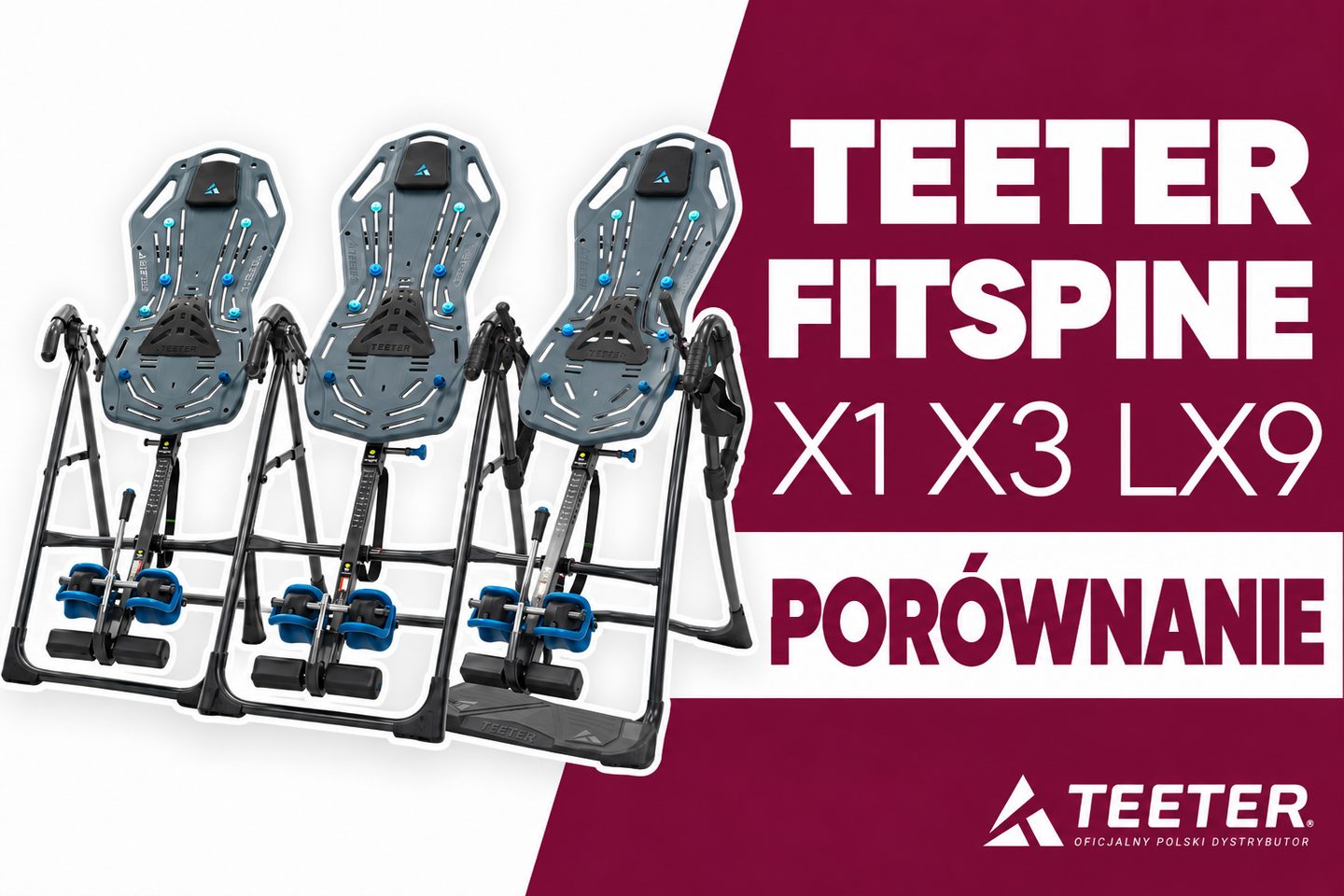
The models differ in their bed, ankle lock and equipment. The Teeter EP-560 has a classic ComforTrak bed. The Teeter FitSpine X1 is the base model with a FlexTech bed. The Teeter FitSpine X3 - our most popular model - has the Deluxe EZ-Reach ankle lock with a long handle and a 20/40/60° angle limiter. The flagship Teeter FitSpine LX9 adds an arched frame, an entry platform and a storage caddy for small accessories, which makes it easier to keep a small corner tidy.
How to use the table according to the manual
The manufacturer's manual describes how to start: with small angles (20-30°) for the first few weeks and short sessions of 1-2 minutes, extended over time to about 3-5 minutes. Most users stay at angles of up to 60°, and full inversion (90°) is an option for advanced users, only once the user has full control over the table's rotation. After returning, rest in a position just past horizontal for 15-30 seconds or longer. In case of pain or dizziness, the manual instructs you to return to upright immediately. You will find details of the settings (shaft height, roller hinges, angle limiter) in the manual for your model.
Where does the FreeStep trainer fit in?
The Teeter FreeStep is training equipment, not a medical device. It is a recumbent cross trainer used in a seated position - you sit on a seat with a backrest while your legs and arms perform a stepping motion, linked together by a mechanism. The magnetic resistance has 13 levels and the console runs on AA batteries, so the equipment doesn't need a power outlet. There are transport wheels at the back of the base. You will find both models - the LT1 and LT3 - in the Teeter Equipment section.
In your corner, FreeStep works well as equipment that stands "at the ready" - e.g. in front of the TV. The console has a holder for a tablet or phone, with space for a water bottle next to it. Remember the 61 cm clearance zone around the equipment and that children and pets must not come near the moving joints. The manufacturer recommends consulting a doctor before starting an exercise program.
Self-massage and stretching accessories
The smallest, and often the most frequently used, items in the corner. In the Recovery and Massage category you will find, among other things, a massage ball, a self-massage stick and the Neck Relax & Restore Duo, and alongside them the Teeter Core Restore cushion. These are accessories, not medical devices - use them as described on the product page and in the instructions. In your corner, it is best to keep them in one container next to the mat so they don't get scattered around the home.
If you have a pull-up bar at home, the Accessories section also has Teeter EZ-Up XL gravity boots for hanging from a bar. Gravity boots are not a medical device - when buying, check on the product page which bars they are compatible with, and follow the instructions.
How to store folding equipment in a small apartment?
Teeter inversion tables fold without tools, which is a big advantage in a small apartment. The manual describes exactly how to do this safely.
Folding an inversion table
- Unclip the angle limiter (the Angle Tether strap).
- Slide the main shaft into the last hole - this is the storage setting.
- Rotate the bed in the direction opposite to use until it rests against the A-frame.
- Fold the frame, leaving the frame legs spread 16-20 in (about 41-51 cm) apart so the table stands stably - or secure it to the wall. Watch your fingers when folding.
Once folded, the table takes up about 51-56 cm in depth and 73-81 cm in width (depending on the model), with a height of about 168-171 cm. It will easily fit in an alcove, behind a door or next to a wardrobe.
Inversion tables and children at home
The manual is clear here: if there are children in the home, the table must be stored folded and laid flat on the floor, not upright. Also, do not store it in a room that children can access unsupervised. If you leave the table unfolded and ready to use, secure it against accidental rotation - e.g. by wrapping the angle limiter strap around the main shaft and crossbar and fastening it with the buckle, as described in the manual.
Storing other items
- Lumbar bridge from the FitSpine tables - the manual recommends storing it in the flat position when not in use, because staying in a high setting for a long time can deform it.
- Acupressure nodes - once removed from the bed, keep them in a container; the LX9 has a storage caddy with a special holder for them. You will find spares in the accessories category.
- The table's owner's manual - it should remain attached to the frame so every user has access to it.
- FreeStep trainer - it doesn't fold, but it has transport wheels. The manual: lift the equipment first by the beam under the console, then by the front crossbar, and roll it on its wheels. It weighs 48.5-50 kg, so do this carefully.
- Mat and accessories - a wall hanger or a basket by the corner. The fewer items lying loose on the floor, the faster you can get the space ready to exercise.
How to plan a week of activity at home?
The hardest part of a home workout corner isn't setting it up, but using it regularly. Below is a sample plan for organizing your week - it is a suggested schedule of activities, not a training plan tailored to your health. Adjust the time and intensity to yourself, and consult a doctor before starting a new exercise program.
| Day | Activity | Equipment |
|---|---|---|
| Monday | easy seated cardio + a few minutes of mat exercises | FreeStep, mat |
| Tuesday | a walk or other activity outside the home | - |
| Wednesday | a workout with different modes (arms and legs, legs only, arms only) | FreeStep |
| Thursday | stretching exercises on the mat, self-massage | mat, self-massage accessories |
| Friday | seated cardio at a slightly higher resistance | FreeStep |
| Saturday | longer outdoor activity (cycling, walking, swimming) | - |
| Sunday | rest day or easy mat exercises | mat |
If there is an inversion table in your corner, plan your sessions according to the manual: starting with small angles and short sessions, gradually. The manual recommends shorter, more frequent sessions instead of long, infrequent ones - that is why the table works well as a permanent part of the corner that you use briefly, rather than as a "big workout" once a week.
A few rules that make consistency easier
- A fixed time - e.g. after work or before dinner. The corner should be ready, not require moving furniture.
- Short sessions instead of rare marathons - 15-20 minutes a few times a week is easier to keep up than an hour-long workout once a week.
- Notes - the FreeStep console shows time, distance, speed and calories. Write them down so you can see your own consistency.
- Listen to the signals - Teeter manuals are clear: stop exercising if you experience pain, dizziness or shortness of breath.
Teeter Move app - how to use it in your home workout corner?
Teeter Move is the manufacturer's free app with video and audio programs - with exercises on and off the inversion table, without a subscription. Access to it comes with Teeter inversion tables, and for FreeStep trainers the manufacturer describes it as on-demand workouts with no subscription. In your workout corner it is useful in two ways:
- As a guide - instead of planning a session yourself, you choose a ready-made program and exercise along with the recording.
- As a technique reminder - especially on the inversion table, where correct setup and a calm pace matter.
Place your tablet or phone so the screen is clearly visible from where you exercise - FreeStep has a device holder on the console, and for the table and mat a stand or a shelf at eye level is enough. For assembling Teeter equipment, a second free app is also useful - BILT, which shows how to assemble the equipment in interactive 3D, step by step.
A safe workout corner - checklist
Finally, a quick list to check before you start using it. All points come from the Teeter equipment manuals:
- The equipment stands on a level surface, away from water, stairs and edges.
- There is clear space around the equipment - 61 cm on each side for FreeStep, and space in front of, above and behind the user for the table.
- Before each use you check that bolts and fasteners are tightened and that knobs and locks are engaged.
- You replace damaged parts immediately and don't use the equipment until it is repaired.
- You wear lace-up shoes with flat soles on the table and check the ankle lock using the "hear, feel, see, check" method.
- Children and pets are kept out of the exercise zone, and in a home with children the table is stored flat on the floor.
- You clean the equipment with a damp cloth - without abrasives or solvents.
- You don't exercise under the influence of alcohol or medications that cause drowsiness or disorientation.
Frequently asked questions
How much space do you need for an inversion table at home?
Teeter inversion tables in use are about 206-213 cm long, 73-81 cm wide and about 218-220 cm high (manufacturer's data). It is worth reserving a rectangle of about 2.5 x 1.5 m and checking that no lamp hangs above the table. The manual requires clear space in front of, above and behind the user.
How should you store a folded inversion table?
Once folded, the table stands upright, and the frame legs should stay spread about 41-51 cm apart, or the frame should be secured to the wall. If there are children in the home, the manual says to store the folded table flat on the floor and not to keep it in a room that children can access unsupervised.
Do you need a mat under an inversion table?
Above all, the manual requires a level, stable surface. The Teeter inversion table mat protects the floor under the equipment and marks its permanent place in the room, so it is worth considering together with the table - especially on laminate and hardwood floors.
Is an inversion table a medical device?
Yes. The Teeter FitSpine X1, X3, LX9 and EP-560 inversion tables are medical devices for home spinal traction with simultaneous stretching of the paraspinal muscles and soft tissues. This is a medical device. Use it in accordance with the instructions for use or the label. Before use, the manual requires consulting a doctor and lists contraindications.
Will a FreeStep trainer fit in a small apartment?
FreeStep is 157.6 cm long and about 141 cm high, and during a workout the manual requires a 61 cm clearance zone around the equipment. The trainer doesn't fold, but it has transport wheels, so after exercising you can roll it to the wall. It doesn't need a power outlet - the console runs on batteries.
Are FreeStep and massage accessories medical devices?
No. FreeStep trainers, the DEX II bench, gravity boots and self-massage accessories are training equipment and accessories, not medical devices. Use them according to the instructions and the description on the product page.
What is the Teeter Move app for?
It is Teeter's free app with video and audio programs - with exercises on and off the inversion table, without a subscription. In your home corner it acts as a guide: you choose a program and exercise along with the recording.
Can children exercise in the home workout corner?
Not on Teeter equipment. The manuals for the inversion tables and the FreeStep trainer prohibit children from using the equipment and say to keep children and pets away from it during exercise. The FreeStep manual adds that children should not be left unsupervised in the room where the equipment stands.
- Teeter FitSpine X3 - the most popular Teeter inversion table, folds without tools, with the Deluxe EZ-Reach ankle lock.
- Teeter FitSpine LX9 - the flagship inversion table with an arched frame, an entry platform and an accessory storage caddy.
- Teeter FreeStep LT3 - a seated recumbent cross trainer with transport wheels and a battery-powered console.
- Teeter inversion table mat - protects the floor under the table and marks the place for your equipment.