Are you wondering whether an inversion table at home is a good buy, or just another piece of equipment that will end up in a corner as a clothes rack after a month? It is a sensible question - a table takes up space, costs money and is not for everyone. In this article we help you make the decision calmly, without promises: we look at who should not buy an inversion table, how much space you really need, how to approach your budget, what the alternatives are (e.g. gravity boots), what everyday use looks like and what you get from buying from the official distributor - warranty, free delivery and a 14-day return policy. At the end you will find a "pros and cons" table and answers to the questions customers ask most often.
What is an inversion table and what is it for?
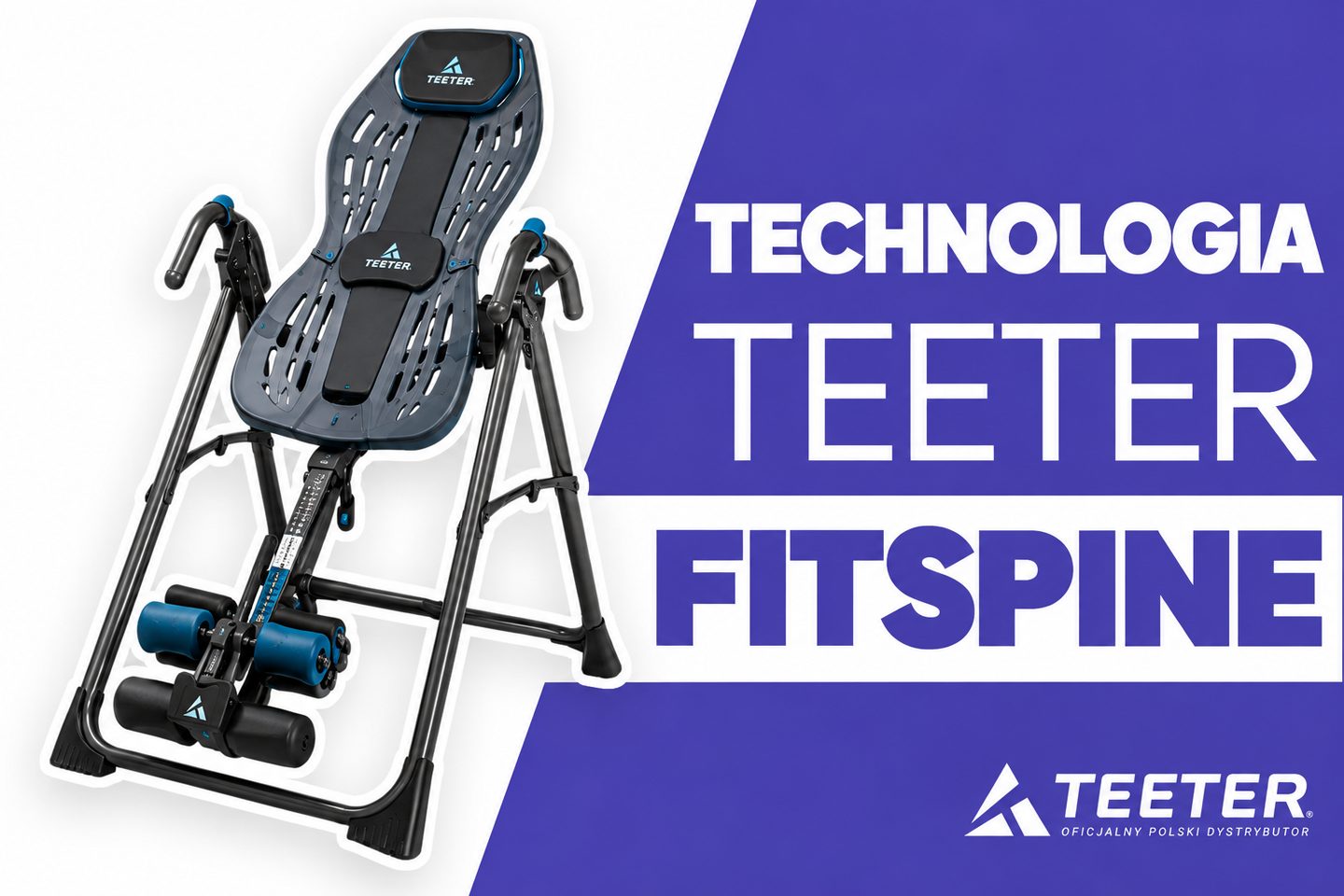
An inversion table (also called a gravity table) is a freestanding frame with a rotating bed. You secure your ankles in the lock, lie back on the bed and use arm movements to rotate to the angle you choose - from a slight tilt to full inversion. You limit the angle with a strap under the bed.
The Teeter FitSpine X1, X3, LX9 and EP-560 tables are CE-marked medical devices. According to the manufacturer, they are intended for home spinal traction with simultaneous stretching of the paraspinal muscles and soft tissues. This is a medical device. Use it in accordance with the instructions for use or the label.
Teeter has been designing inversion tables since 1981 in Bonney Lake, USA, and according to the manufacturer more than 3 million people around the world use them. That does not mean, however, that a table is the right choice for you - the questions below decide that.
Who should not buy an inversion table?
We start here because this is the most important filter. The Teeter manual is clear: do not use the table until you have your doctor's approval. Inversion is contraindicated in any condition that could be worsened by increased blood pressure, increased intracranial pressure or the strain associated with the inverted position. The manual lists, among others:
- neurological conditions causing unexplained tingling, weakness, dizziness or disorientation,
- brain conditions, e.g. injury, previous intracranial bleeding, a previous stroke or risk of stroke,
- heart and circulatory conditions, e.g. high blood pressure, hypertension, use of anticoagulants,
- bone and spine conditions, e.g. significant curvature, osteoporosis, fractures, surgically implanted orthopedic supports,
- eye and ear conditions, e.g. glaucoma, retinal detachment, ocular hypertension, motion sickness,
- reflux, hernias, gallbladder or kidney disease,
- pregnancy, obesity, recent surgery.
This is not a complete list - the manual is what counts. The table is also not for children, and the user range is 142-198 cm in height and up to 136 kg. That is why our first piece of advice is: talk to your doctor before you buy, not after you unpack the box. We cover this in detail in our article on inversion contraindications.
Do you have room for an inversion table?
The second filter is space. In use, the table measures approx. 206-213 cm long, 73-81 cm wide and approx. 218-220 cm high. On top of that you need clear space in front of, above and behind the table for rotation, and to the side for getting on and off. The table must stand on a level surface, indoors, away from water and edges.
The good news: Teeter tables fold without tools. Folded, they take up approx. 51 x 73 cm of floor space (EP-560, X1, X3) or approx. 56 x 81 cm (LX9), at a height of approx. 168-171 cm. If there are children in the home, the manual says to store the folded table flat on the floor.
A simple test before you buy: mark a rectangle the size of the table on the floor with tape, check the ceiling and light fixtures above it and think about whether the table will stay set up or whether you will fold it away. A table you have to pull out from behind the wardrobe every time is more likely to stop being used.
Will you use it regularly?
The Teeter manual describes a way of using the table that does not take much time but does require regularity:
- to start, short 1-2 minute sessions at a small angle of 20-30°,
- gradually extending to about 3-5 minutes,
- according to the manufacturer, frequency matters more than duration - shorter, more frequent sessions instead of long, infrequent ones,
- checking the settings and securing your ankles before each use.
Ask yourself: can you find a few minutes in your day for a session, plus a moment to get the table ready? If so, the table has a good chance of becoming part of your routine. We describe a plan for the first weeks in the guide how to use an inversion table.
How should you approach your budget?
Store prices change, so we do not list them in this article - you will find current prices on the product pages. Instead, we explain what you are paying for in more expensive and cheaper models:
- Common to all the Teeter tables we offer: a range of 142-198 cm and up to 136 kg, full inversion with a lock, a roller hinge with 3 settings, tool-free folding, UL safety certification and a 5-year warranty.
- Differences: the type of bed (ComforTrak or FlexTech with 8-point suspension), the ankle lock (T-pin or Deluxe EZ-Reach with a long handle), an angle limiter with markings, extra handles, the frame and a storage caddy.
With cheaper tables outside our range, it is worth checking whether the manufacturer states the height and weight range, whether the table has balance adjustment, what the ankle lock looks like, whether there is a manual in your language and whether parts are available. We write more about selection criteria in the guide which inversion table is best.
What are the alternatives to an inversion table?
Not everyone needs a table. Before you decide, it is worth knowing the other options:
Gravity boots
You put gravity boots on your ankles and hook them onto a bar. They take up little space, but require a securely mounted bar, arm and core strength, and agility, because you have to lift your legs up to the bar and get down from it safely. There is only one angle - a full hang. Teeter EZ-Up XL boots are not a medical device - they are an accessory for hanging exercises. You will find a comparison in the article gravity boots.
Exercise without inversion equipment
Walking, stretching on a mat, general fitness training or seated exercises are options that do not require an inverted position. If you are looking for home exercise equipment that is not a table, take a look at the Teeter FreeStep trainers - exercise equipment for working your arms and legs in a seated position.
| Option | Space | Requirements | Status |
|---|---|---|---|
| Teeter inversion table | approx. 2 x 0.8 m in use, folding | doctor's approval, 142-198 cm, up to 136 kg, user settings | medical device (CE) |
| Gravity boots + bar | doorway bar or a stand | strength, agility, a sturdy bar | training accessory |
| FreeStep trainer | a permanent spot on the floor | seated exercise | exercise equipment |
| Mat and equipment-free exercise | minimal | motivation and regularity | - |
An inversion table at home - pros and cons
| Pros | Cons |
|---|---|
| Sessions last a few minutes and take place at home, whenever it suits you | Not for everyone - requires a doctor's approval and has contraindications |
| Smooth angle adjustment and a limiter - you can stay at small angles | Takes up a fair amount of space in use and needs a room with a high ceiling |
| One table for several adults in the household (each with their own settings) | You need to check the settings and secure your ankles before each use |
| Tool-free folding, 5-year warranty | Requires assembly after delivery |
| You get on standing up, without pulling yourself up as with boots | It is worth doing the first sessions with another person present |
What is everyday life with an inversion table like?
Before you buy, it is worth picturing an ordinary week with the table. From conversations with customers we know that small things decide whether a table gets used:
- Assembly - a one-time job, usually with a second person, with help from the BILT app. After assembly you need to adjust the table to yourself.
- Getting ready for a session - checking the table, flat-soled shoes, securing your ankles with the "hear, feel, see, check" method. Over time this takes only a moment.
- Several household members - each has their own settings (main shaft, roller hinge, angle, Ankle Comfort Dial). It is worth writing them down and keeping them by the table.
- Children in the home - the manual prohibits them from using the table and says to store it folded, flat on the floor, when children are present.
- Maintenance - wiping with a damp cloth and an inspection before each use. Damaged parts are replaced immediately.
If after reading this list you think "that is doable for me", the table has a good chance of staying in use. If not, it is better to know that before you buy.
Which model should you choose if you decide to buy?
- Teeter EP-560 - classic ComforTrak bed, T-pin lock, adjustable angle strap.
- Teeter FitSpine X1 - FlexTech bed with 8-point suspension and T-pin lock.
- Teeter FitSpine X3 - the most popular choice: Deluxe EZ-Reach lock you secure without bending down, 20/40/60° limiter, Stretch Max and EZ-Stretch handles.
- Teeter FitSpine LX9 - everything the X3 has, plus the arched LX frame, an entry platform and a storage caddy.
You will find the detailed differences in the FitSpine X1, X3 and LX9 comparison, and all models in the inversion tables category.
Warranty, delivery and returns - what do you get from buying from the official distributor?
Teeter.pl is the official distributor of the Teeter brand in Poland. When you buy a table, you get:
- a 5-year warranty on inversion tables,
- a Polish-language manual and help from our customer service team,
- free delivery and shipping within 24 hours,
- prices in EUR and shipping directly from Poland,
- a 14-day return policy - you have time to check whether the table suits your home.
If you are unsure which model will fit in your home or what assembly involves, call or write to us - we will help you choose a table that suits your space and your household.
Frequently asked questions
Is it worth buying an inversion table for home?
It is worth considering if your doctor sees no contraindications, you have the space and you can find a few minutes a day for regular, short sessions in line with the manual. If any of these conditions is not met, it is better to wait or choose another form of exercise.
Do I need to see a doctor before buying?
The manual requires a doctor's approval before using the table. It makes sense to talk to your doctor even before you buy, so you do not purchase equipment you will not be able to use.
How much space does the table need?
In use, approx. 206-213 cm long, 73-81 cm wide and approx. 218-220 cm high, plus extra room for rotation and getting on. Folded, approx. 51 x 73 cm or 56 x 81 cm of floor space.
Is an inversion table a way to deal with back pain?
We do not present the table as a way to deal with any ailment. Teeter FitSpine tables are medical devices for home spinal traction with simultaneous stretching of the paraspinal muscles and soft tissues, and they have contraindications. Your doctor decides whether you can use one.
Table or gravity boots?
A table gives you angle adjustment, a limiter and getting on while standing. Boots require a bar, strength and agility, and there is only one angle - a full hang. Teeter tables are medical devices, while EZ-Up boots are a training accessory.
Can I return the table?
Yes, you have 14 days to return it. You will find details of the return process and the condition in which the product should be sent back in the store terms and conditions, or you can get them from our customer service team.
What currency are the prices in?
Prices in the English version of the store are in EUR. You will see the available payment methods when placing your order.
Does the table require assembly?
Yes, the table arrives in a box. The manufacturer provides the free BILT app with 3D assembly instructions, and the manual recommends assembling the table in the place where it will be used.
Recommended products
- Teeter FitSpine X3 - our most popular model, with the Deluxe EZ-Reach lock and a 20/40/60° limiter.
- Teeter FitSpine X1 - FlexTech bed and T-pin lock in the entry model of the series.
- Teeter FitSpine LX9 - the flagship table with the arched frame, entry platform and storage caddy.
- Teeter EZ-Up XL - gravity boots for hanging from a bar, a training accessory.