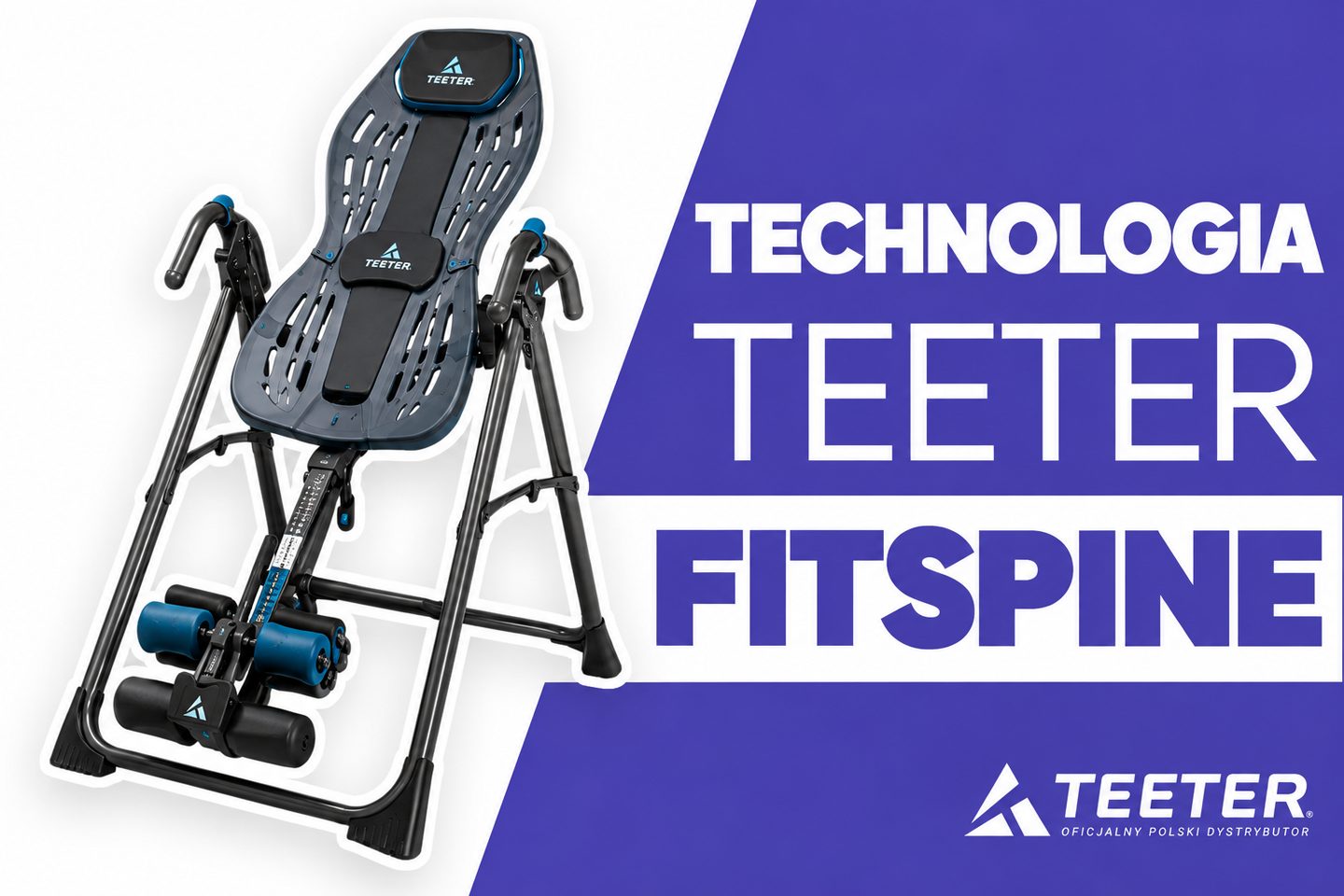
An inversion table is a sizable piece of equipment: in use it is over 2 meters long and about 2.2 meters tall, and it also rotates, so it needs free space around it. Before you choose a model, it pays to line up the hard numbers: dimensions in use and folded, the weight of the table, the user height range and weight limit, angles and the type of lock. In this article we have gathered the specifications of the Teeter EP-560, FitSpine X1, X3 and LX9 inversion tables in one table and worked out what they mean when picking a spot at home: how much floor the table takes up, how much when folded, how high the ceiling should be and how to move it. The data comes from the manufacturer's documentation. We compare features (bed, handles, comfort) separately in the article Teeter FitSpine X1, X3 and LX9 - comparison.
What are the dimensions and specifications of Teeter inversion tables?
Below is a full overview of the four Teeter inversion tables we offer. Dimensions are given in the order: length x width x height.
| Specification | EP-560 | FitSpine X1 | FitSpine X3 | FitSpine LX9 |
|---|---|---|---|---|
| Dimensions in use | 213.4 x 73.2 x 218.4 cm | 205.7 x 73.2 x 219.7 cm | 205.7 x 73.2 x 219.7 cm | 207.4 x 81.2 x 219.6 cm |
| Folded dimensions | 50.8 x 73.2 x 167.6 cm | 50.8 x 73.2 x 167.6 cm | 50.8 x 73.2 x 167.6 cm | 56.1 x 81.2 x 171.1 cm |
| Table weight | 26.7 kg | 27.4 kg | 29.9 kg | 33.4 kg |
| User height | 142-198 cm | 142-198 cm | 142-198 cm | 142-198 cm |
| Max. user weight | 136 kg | 136 kg | 136 kg | 136 kg |
| Inversion angle | up to 90° | up to 90° | up to 90° | up to 90° |
| Angle limiter | Angle Tether (adjustable strap) | Angle Tether (adjustable strap) | EZ-Angle Tether 20/40/60° | EZ-Angle Tether 20/40/60° |
| Full inversion with lock | yes | yes | yes | yes |
| Ankle lock | T-pin | T-pin | Deluxe EZ-Reach | Deluxe EZ-Reach |
| Roller hinge | 3 settings | 3 settings | 3 settings | 3 settings |
| Frame | straight, powder-coated steel | straight, powder-coated steel | straight, larger-diameter tubing | curved LX, larger-diameter tubing |
| UL strength test | approx. 544 kg | approx. 544 kg | approx. 544 kg | approx. 544 kg |
| Warranty | 5 years | 5 years | 5 years | 5 years |
The first takeaway is simple: the user range is identical across all models - 142-198 cm and up to 136 kg. So height or weight does not decide which model to choose. The differences in the numbers mainly concern the weight of the table itself and the size of the LX9, which is wider and slightly taller when folded.
How much space does an inversion table take up in use?
We converted the dimensions from the table into the floor area taken up by the set-up table (rectangular footprint):
| Model | Footprint in use | Footprint folded | Space regained when folded |
|---|---|---|---|
| EP-560 | approx. 1.56 m² | approx. 0.37 m² | approx. 76% |
| FitSpine X1 | approx. 1.51 m² | approx. 0.37 m² | approx. 75% |
| FitSpine X3 | approx. 1.51 m² | approx. 0.37 m² | approx. 75% |
| FitSpine LX9 | approx. 1.68 m² | approx. 0.46 m² | approx. 73% |
That is only the footprint of the table itself, though. During a session the bed rotates, so the manual reminds you to make sure before use that there is enough room in front of you, above you and behind you for rotation. In practice, plan a strip of free floor at least as long as the table plus a margin of several dozen centimeters at each end along the axis of rotation, and at the sides - room to step in comfortably and spread your arms.
Which room should you choose?
- A rectangular strip of floor - the table "works" along its length, so a narrow but long space works better than a square corner.
- Away from furniture with sharp edges, shelves and water - the manual recommends setting it up on a level surface, away from water or edges that could cause a fall.
- Out of children's reach - the manual prohibits storing the table in a room children can access unsupervised.
- Indoors - the table is intended for indoor home use only, not for a patio or a garage exposed to moisture.
On laminate, tiles or hardwood, an inversion table mat comes in handy - it protects the floor and limits frame movement. You will find more ideas for organizing your home workout space in the accessories category.
How high does the ceiling need to be for an inversion table?
Set up, Teeter inversion tables are 218.4 to 219.7 cm tall. In a typical apartment with a ceiling of about 2.5 m, that leaves about 30 cm of clearance. In lower rooms, for example in an attic with sloped ceilings, measure the height exactly where the table will stand and check that there is no lamp, beam or fan above it.
Also keep in mind the person using the table: when getting on and off you stand inside the frame, and with your arms raised your hands may reach higher than the table itself. For tall users (closer to 198 cm), overhead clearance matters especially.
How much space does the table take up when folded?
All Teeter inversion tables fold without tools. Folded, the EP-560, X1 and X3 have a base of approx. 51 x 73 cm and a height of 168 cm, and the LX9 - approx. 56 x 81 cm and 171 cm. That is close to the size of a tall cabinet, so the table can be tucked into a corner, behind a door or into a walk-in closet.
The manual lists important numbers and rules for folding:
- before folding, detach the angle limiter and slide the main shaft to the last hole,
- leave the frame legs spread approx. 40-50 cm (16-20 inches) apart so the folded table stands stably, or secure it against a wall,
- if there are children in the home, store the table folded and laid flat on the floor, not upright,
- if you leave the table unfolded, secure it against accidental rotation, for example by looping the limiter strap around the main shaft and the crossbar.
How much do Teeter inversion tables weigh and can you move them?
The tables weigh from 26.7 kg (EP-560) to 33.4 kg (LX9). That is a lot for carrying up and down stairs every day, but light enough for one person to slide or tilt a folded table and move it around a room. The assembly manual recommends assembling the table in or near the place where you will use it - so you avoid carrying the finished structure.
The 6.7 kg difference between the lightest and heaviest model comes from features and construction: the X3 and LX9 have larger-diameter frame tubing, a longer lock lever and extra handles, and the LX9 also has a curved frame, a step-up platform and a storage caddy.
What other numbers are worth knowing before first use?
Besides dimensions, the manual contains a few numbers that come in handy when setting up the table and during your first sessions:
| Number | What it refers to (per the Teeter manual) |
|---|---|
| +2.54 cm | initial main shaft setting: 1 inch more than your height (e.g. 178 cm height - 180 cm setting), then adjust by one hole |
| 3 holes | roller hinge: from the most to the least responsive rotation; setting A is not used above 100 kg |
| 2.54 cm | difference between the high and low setting of the Ankle Comfort Dial |
| 20°, 40°, 60° | markings on the EZ-Angle Tether in the X3 and LX9 |
| 20-30° | recommended angle for the first weeks |
| 1-2 min | length of the first sessions; over time usually approx. 3-5 min |
| 15-30 s | rest in the horizontal position before returning upright |
| 4 pairs | acupressure nodes included with every table |
These numbers describe the method of use set out by the manufacturer, not a promise of results. You will find the full procedure in the guide how to use an inversion table.
The Teeter EP-560, FitSpine X1, FitSpine X3 and FitSpine LX9 inversion tables are CE-marked medical devices intended for home spinal traction with simultaneous stretching of the paraspinal muscles and soft tissues. This is a medical device. Use it in accordance with the instructions for use or the label. Consult a doctor before use - we describe contraindications in the article who an inversion table is right for.
Which model should you choose looking only at the numbers?
- Least space when folded: EP-560, X1 and X3 - identical folded dimensions (50.8 x 73.2 x 167.6 cm).
- Shortest in use: X1 and X3 (205.7 cm). The EP-560 is approx. 8 cm longer.
- Lightest: EP-560 (26.7 kg), closely followed by X1 (27.4 kg).
- Widest and heaviest: LX9 (81.2 cm, 33.4 kg) - in return it has a curved frame, a step-up platform and a storage caddy.
- Angle set without guesswork: X3 and LX9 with 20/40/60° markings.
Whether to pay extra for the X3 or LX9 depends on features rather than dimensions - we describe them in the FitSpine X1, X3 and LX9 comparison and in the guide which inversion table is best. You will find all models in the inversion tables category.
How to bring in and assemble the table in an apartment?
The table arrives in a box and requires assembly. A few practical numbers and rules worth knowing before delivery:
- Assemble on site. The assembly manual recommends putting the table together in or near the place where you will use it - the finished structure weighs 26.7-33.4 kg and is over 2 m long.
- Prepare your workspace. Unpack all parts, set the packaging aside and clear the floor. The hardware packs are labeled to match the assembly steps.
- Use the BILT app. The free interactive 3D instructions guide you through assembly step by step - you can rotate and zoom the model and repeat any stage.
- Check doorways. The folded table is 73.2 cm wide (LX9 - 81.2 cm) and approx. 168-171 cm tall. If you plan to move it between rooms, measure doors and hallways beforehand.
- Keep the manual with the table. The owner's manual is attached to the frame with a chain and should stay there permanently as a reference for all users.
After assembly and before first use, check that the table rotates smoothly to full inversion and back and that all fasteners are secured. The manual recommends this check before every use.
Frequently asked questions
How much space do you need for an inversion table?
In use, the table itself takes up approx. 1.5-1.7 m² of floor (approx. 206-213 cm long and 73-81 cm wide). On top of that you need free clearance in front of, above and behind the table, because the bed rotates during a session.
How tall does a room need to be for a Teeter inversion table?
Set up, the tables are approx. 218-220 cm tall. A room with a ceiling of about 2.5 m leaves reasonable clearance, but always measure the spot where the table will stand.
How much does a Teeter inversion table weigh?
From 26.7 kg (EP-560) through 27.4 kg (X1) and 29.9 kg (X3) to 33.4 kg (LX9).
Can a Teeter inversion table be folded?
Yes, without tools. Folded, the EP-560, X1 and X3 measure 50.8 x 73.2 x 167.6 cm, and the LX9 - 56.1 x 81.2 x 171.1 cm. The frame legs are left spread approx. 40-50 cm apart, or the table is secured against a wall.
What is the maximum user height and weight?
In all models 142-198 cm and up to 136 kg. The manual prohibits use of the table by taller or heavier people.
Do all Teeter inversion tables allow full inversion?
Yes, all of them allow rotation up to 90° with a lock in the inverted position. However, the manual recommends starting at 20-30° and going to full inversion only once you have confident control of rotation at 60°.
Which Teeter inversion table takes up the least space?
In use, the shortest are the FitSpine X1 and X3 (205.7 cm). Folded, the EP-560, X1 and X3 have identical, smallest dimensions.
Recommended products
- Teeter FitSpine X1 - the shortest in use and compact when folded, with a FlexTech bed.
- Teeter FitSpine X3 - the same dimensions as the X1, plus the Deluxe EZ-Reach ankle lock and the 20/40/60° limiter.
- Teeter FitSpine LX9 - a wider, curved LX frame with a step-up platform and a storage caddy.
- Inversion table mat - floor protection where the table will stand.