"You have an L5-S1 herniation" or "the MRI shows a disc bulge" - a sentence like that can be frightening, especially when it comes with severe back or leg pain. Questions immediately come to mind: is it dangerous, will I need surgery, am I allowed to move, how do I work and sleep now? In this article we explain what a herniated disc is, what symptoms it causes, which of them are red flags, how it is diagnosed and which treatment options a doctor may consider. We also describe how many people organize their daily lives with this diagnosis. This is an informational article - your treatment plan is always set by your doctor.
This article is for informational purposes only and does not replace medical advice. If you have symptoms, consult a doctor.
What is a herniated disc?
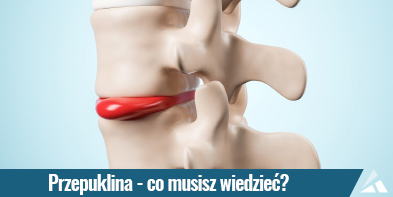
Between the vertebral bodies lie the intervertebral discs. Each one has two parts: a tougher, fibrous ring on the outside (the annulus fibrosus) and a gel-like core in the center (the nucleus pulposus). The discs connect the vertebrae, allow the spine to move and distribute loads.
A disc herniation is when part of the disc material moves beyond its normal boundaries - most often backward or to the side, toward the spinal canal and the nerve roots. If the displaced fragment irritates or compresses a nerve root, symptoms may appear in the arm or leg. A herniation may also cause no symptoms at all.
Bulge, herniation, degenerative disc disease - what is the difference?
| Term | What it usually means |
|---|---|
| Discopathy | A general, informal term for changes in an intervertebral disc, often used interchangeably with herniation |
| Degenerative disc changes | Loss of disc height and hydration, common with age, also in people without symptoms |
| Bulge (protrusion) | The disc extends beyond the outline of the vertebral bodies, but the annulus fibrosus is largely intact |
| Herniation (extrusion) | Nucleus material pushes through the annulus fibrosus |
| Sequestration | A fragment of the disc separates and moves within the spinal canal |
Terminology in imaging reports varies, and the extent of changes on imaging does not always match the severity of symptoms. That is why test results are always discussed with a doctor in relation to how you feel.
Where does a herniation most often occur?
Most often in the lumbar spine, especially at the L4-L5 and L5-S1 levels, which carry heavy loads. The second typical location is the cervical spine (e.g. C5-C6, C6-C7). Herniations in the thoracic spine are less common.
What are the symptoms of a herniated disc?
Symptoms depend on the level of the herniation, its size and whether it irritates nerve structures.
Lumbar spine
- lower back pain,
- pain radiating to the buttock and leg, often below the knee - the typical picture of sciatica,
- tingling, numbness or an "electric shock" sensation along a specific strip of the leg or foot,
- muscle weakness, e.g. difficulty walking on your heels or toes,
- pain that gets worse when coughing, sneezing, straining or sitting for a long time.
Cervical spine
- neck and shoulder pain,
- pain radiating down the arm, sometimes to the fingers,
- numbness or tingling in the arm, weaker grip.
Many people have a herniation visible on imaging but no pain - disc changes are often an incidental finding. On the other hand, similar symptoms can be caused by other problems, such as spinal stenosis, hip joint changes or peripheral nerve disorders.
When does a herniated disc need urgent care?
In most cases a herniated disc is not an emergency. However, some symptoms may indicate severe compression of the nerves or the spinal cord.
Go to the ER immediately or call 112
- numbness in the groin, around the anus or on the inner thighs (saddle anesthesia),
- problems urinating, urinary retention, loss of bladder or bowel control,
- rapidly worsening weakness in one or both legs, foot drop,
- with a cervical herniation: weakness in both arms, clumsy hands, problems with walking and balance.
See a doctor urgently
- very severe pain that cannot be controlled with the medication prescribed by your doctor,
- new numbness or weakness,
- pain with fever, after an injury, or in someone with a history of cancer,
- constant pain that gets worse at night and does not depend on position.
What causes a herniated disc?
Most often there is no single cause. With age, discs lose hydration and elasticity, and the annulus fibrosus becomes less resilient. Various factors add to this. The most commonly cited include:
- age and natural degenerative changes,
- repetitive loading - lifting, working bent over, vibration (e.g. professional drivers),
- sudden overload, e.g. lifting a heavy object while twisting your torso,
- prolonged sitting and low physical activity,
- excess body weight,
- smoking,
- genetic factors - in some people disc changes run in the family.
How is a herniated disc diagnosed?
The foundation is a medical history and a neurological examination. The doctor asks about the course of your symptoms, assesses spinal mobility, muscle strength, sensation and reflexes, and performs tension tests (e.g. the straight leg raise). This often makes it possible to determine which nerve root is involved.
- Magnetic resonance imaging (MRI) - the main imaging test when a herniation is suspected. It is usually ordered with red-flag symptoms, worsening neurological symptoms, when symptoms persist despite treatment or when a procedure is being considered.
- Computed tomography (CT) - when an MRI is not possible or bone structures need to be assessed.
- X-ray - does not show discs or nerves, but allows assessment of the bones, vertebral alignment and instability.
- EMG - in selected cases, to assess the extent of nerve damage.
Patients with a herniated disc usually see a primary care doctor first, and then a neurologist, an orthopedic specialist or a neurosurgeon, as well as a physical therapist.
How do you read a spine MRI report?
An MRI report can be full of confusing terms and it is easy to be scared by it. A few things worth knowing before you discuss the results with your doctor:
- Level labels - e.g. L4-L5 is the disc between the fourth and fifth lumbar vertebrae, L5-S1 is between the last lumbar vertebra and the sacrum, C5-C6 is between cervical vertebrae.
- Direction of the herniation - the report may indicate whether the disc material extends centrally, to the side or toward the intervertebral foramen. This matters for which nerve root may be irritated.
- Contact with the nerve root - phrases such as "indents the thecal sac" or "contacts the nerve root" describe the relationship between the disc and nerve structures, but their clinical significance is assessed by a doctor.
- "Additional" findings - reports often also mention degenerative changes, bulges at other levels or disc dehydration. Many of these occur in people without symptoms.
Most importantly: an imaging report is not a diagnosis. Your doctor compares it with the results of the neurological exam and your symptoms. Do not draw conclusions on your own and do not make treatment decisions based solely on the report.
How is a herniated disc treated?
Treatment is always managed by a doctor and tailored to your symptoms, not just to the image on a scan. In general, there are two approaches.
Conservative treatment
Most people start with non-surgical methods. These may include: education and discussion of how symptoms typically progress, advice to stay active within tolerance, medication chosen by a doctor, and physical therapy, in which a specialist assesses your movement and selects exercises. In selected cases a doctor may consider image-guided injections. The course is individual - in many people symptoms gradually ease, while in some they last longer or come back.
Surgical treatment
Surgery is considered, among other situations, with symptoms of cauda equina syndrome (urgently), with progressive weakness, and with severe radicular pain that persists despite appropriate conservative treatment. The decision is made by a specialist after reviewing the tests and talking with the patient about the benefits and risks.
Be cautious with offers to "treat a herniation" without an examination or a conversation with a doctor, and with promises that some method will "reverse a herniation" within a set time. Also do not try to "realign" your spine on your own.
How do you manage daily life with a herniated disc?
Daily habits are not a form of treatment, but they can make everyday activities less of a burden. It is worth agreeing on specific recommendations with your doctor or physical therapist, as they differ depending on the phase of your symptoms.
| Situation | What to pay attention to |
|---|---|
| Movement | Short, frequent walks instead of lying down for long periods; activity within your pain tolerance |
| Sitting | A chair with lumbar support, breaks every 30-60 minutes, alternating between sitting and standing work when possible |
| Lifting | Avoid lifting while twisting; bend your knees, keep the load close to your body |
| Sleep | The position in which pain is lowest, e.g. on your side with a pillow between your knees |
| Getting out of bed | Roll onto your side, push up with your arms, do not sit up in one motion |
| Work and driving | Breaks during trips, seat set close to the steering wheel; do not drive if your leg is weak |
| Sports | Return gradually and after consultation; choose activities together with a specialist |
We describe general principles of lower back care in our article on the lumbar spine, and general information about back pain and red flags in the article back pain - when to see a doctor. Exercises for a herniated disc should be selected by a physical therapist. Do every exercise without pain, and if the pain in your leg or arm gets worse, the numbness spreads or weakness appears, stop and contact your doctor.
Frequently asked questions
What is a herniated disc?
It is a displacement of part of an intervertebral disc beyond its normal boundaries. If it irritates or compresses a nerve root, it can cause pain radiating to the leg or arm, numbness or weakness. It may also cause no symptoms.
Is a herniated disc dangerous?
It is usually not an emergency, but it requires medical evaluation. Urgent help is needed for: numbness in the groin area, problems with urination or bowel movements, rapidly worsening weakness in the limbs.
Can a herniated disc be reabsorbed?
In some people symptoms ease over time, and follow-up imaging sometimes shows a smaller herniation. However, the course is highly individual and cannot be predicted. Management and follow-up are decided by a doctor.
Does a herniated disc require surgery?
Not always. Most people start with conservative treatment. Surgery is considered, among other things, with red-flag symptoms, progressive weakness or severe pain that persists despite treatment. A specialist makes the decision.
What kind of doctor treats a herniated disc?
Start with a primary care doctor, and then most often a neurologist, orthopedic specialist or neurosurgeon. Exercises are selected by a physical therapist.
Can you walk and exercise with a herniated disc?
General guidelines more often point to activity within your pain tolerance than to prolonged bed rest. The type and scope of exercise should be chosen by a physical therapist or doctor.
What is the difference between a disc bulge and a herniation?
With a bulge, the disc extends beyond the outline of the vertebral bodies, but the annulus fibrosus is largely intact. With a herniation, nucleus material pushes through the annulus. The significance of the result is assessed by a doctor together with your symptoms.
Can you use an inversion table with a herniated disc?
This is for your doctor to decide - Teeter FitSpine inversion tables are medical devices, and inversion has contraindications listed in the manual, which we discuss in our article on inversion contraindications. This is a medical device. Use it in accordance with the instructions for use or the label.
Helpful resources
- Sciatica - symptoms, causes and situations that require urgent medical care.
- The lumbar spine - sitting, lifting, sleep and everyday movement.
- Back pain - when to see a doctor and which habits are worth changing.
- Teeter Core Restore - a PVC rubber wedge cushion for sitting with lumbar support, active sitting and balance exercises.