Looking for an inversion table for your home, and after a few minutes of browsing offers your head is spinning? Some models look almost identical but differ in the ankle lock or the bed, others tempt you with "adjustable everything", yet the description says nothing about the height range they are designed for. In this guide we show you how to choose an inversion table sensibly: what to look at first (height and weight range, ankle lock, bed, angle limiter), how much space you really need, how the Teeter FitSpine X1, X3, LX9 and EP-560 inversion tables differ, and which model works in which situation. At the end you will find a list of things worth checking on any table, regardless of brand, and answers to our customers' most frequent questions.
What is an inversion table and how does it differ from a gravity table?
Inversion table, gravity table, inversion bench - these are three names for the same device. It consists of an A-frame, a bed you lie on and a main shaft ending in an ankle lock. The bed is mounted on a pivot, so once your feet are secured you can lean back and rotate to a position with your head lower than your feet - partially or, on models that allow it, all the way to full inversion (90°).
The name "gravity" comes from the fact that the table has no drive at all. You control movement solely with your own body weight: raise your arms overhead and the table starts to rotate; lower them along your torso and the table returns toward upright. For this to work smoothly and predictably, the table must be balanced for the specific user - hence the main shaft adjustment by height and the roller hinge with several settings. This balancing precision is one of the biggest differences between tables, even though store descriptions talk about it the least.
The Teeter inversion table as a medical device
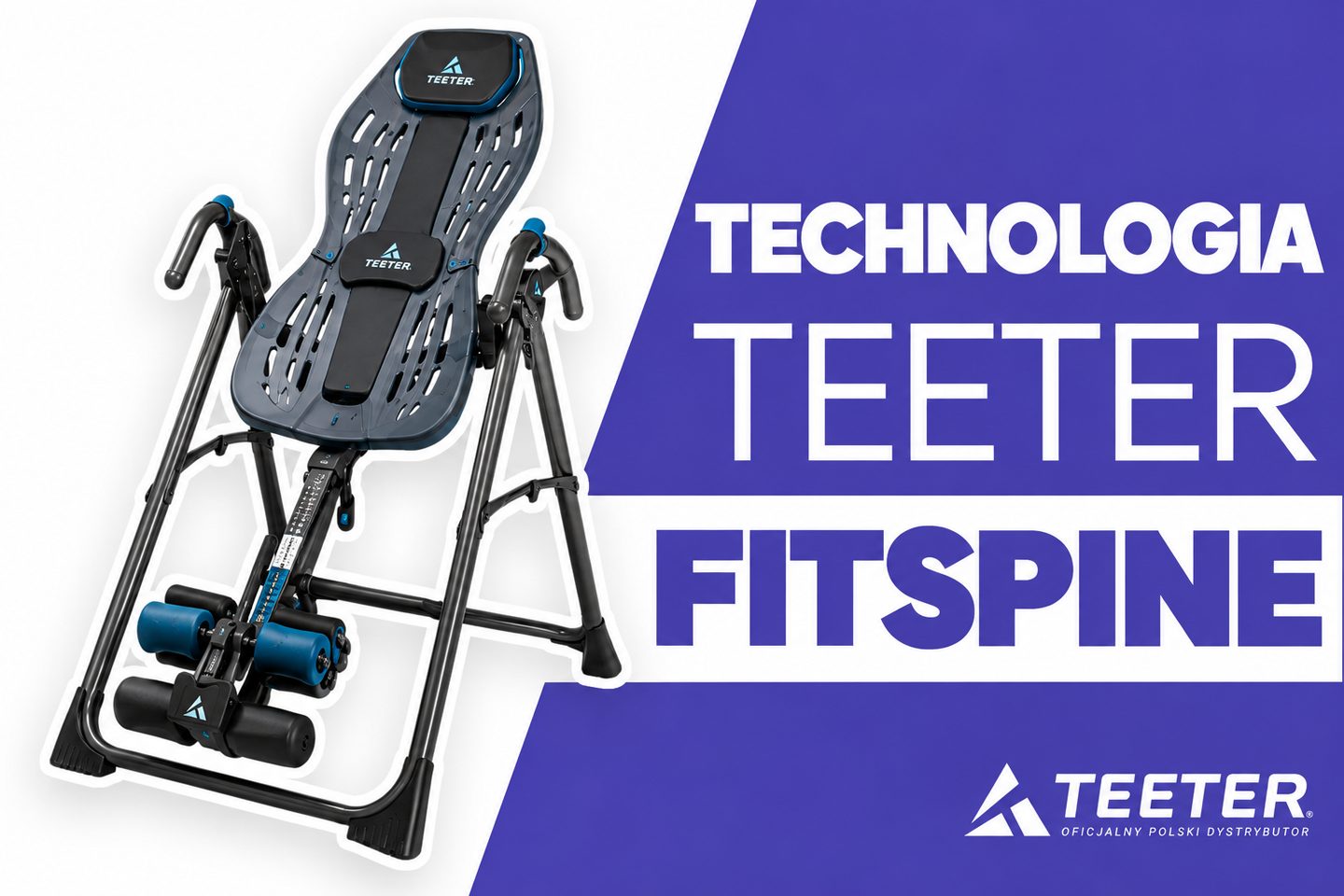
The Teeter FitSpine X1, X3, LX9 and EP-560 inversion tables are CE-marked medical devices. In its documentation the manufacturer calls them decompression devices and defines their intended purpose as home spinal traction with simultaneous stretching of the paraspinal muscles and soft tissues. Traction is non-powered, and the devices are intended for adults, for indoor home use. In the USA, Teeter inversion tables are registered with the U.S. FDA as medical devices (510(k)) - in the European Union, the device status is determined by the CE marking.
This is a medical device. Use it in accordance with the instructions for use or the label.
For you as a buyer this has practical significance: a medical device has a clearly defined intended purpose, with warnings and contraindications described in the manual. Before you decide to buy, it is worth reading them - we write about this further on.
How to choose an inversion table for your home? 8 criteria that really matter
You can tell a good inversion table not by the number of "gadgets", but by how a few basic elements are designed: fit to the user, foot securing, angle control and the stability of the structure. Below we discuss them in the order in which we ourselves advise customers over the phone.
1. User height range and maximum weight
This is the first specification to check - and the only one you cannot "work around". All Teeter inversion tables we offer are designed for people from 142 to 198 cm tall and weighing up to 136 kg. The manufacturer's manual states it plainly: do not use the device if you are taller than 198 cm or weigh more than 136 kg, because the structure may be damaged or your head or neck may hit the floor during inversion.
If the table is to be used by several people at home, check that everyone falls within this range. Changing users also means readjusting the settings each time - fortunately, on Teeter tables the main shaft has a height scale, so it only takes a moment.
2. Ankle lock - T-pin or Deluxe EZ-Reach?
The ankle lock is the element that bears your entire body weight in the inverted position. That is why it deserves the most attention. On Teeter tables you will find two solutions:
- T-pin (FitSpine X1, EP-560) - a spring-loaded lock with a T-shaped handle. You can hear and see it click into place. A simple, proven solution, but you have to bend down to fasten it.
- Deluxe EZ-Reach (FitSpine X3, LX9) - an extended lever and a micro-adjustable ratchet. You secure your feet without bending down and tighten the cushions precisely to your ankles. It has an additional gravity-activated lock, and its components are made of aircraft-grade steel.
In both cases your feet are held by Ergo-Embrace supports made of soft foam that distribute pressure on the ankles, and the Ankle Comfort Dial lets you set the foot platform in a high or low position (a difference of approx. 2.54 cm) so that the cushions wrap the narrowest part of your ankles. If you have trouble bending down or want comfort when fastening every day, the EZ-Reach lock is the most common reason customers choose the X3 over the X1.
3. Bed - FlexTech or ComforTrak?
The bed determines how your body behaves on the table during rotation and stretching. The FitSpine series (X1, X3, LX9) has a FlexTech bed with 8-point suspension - a firm, smooth surface on which the body slides freely as you lean back. The bed "floats" above the frame and flexes with your body during bends and twists.
The EP-560 model has a ComforTrak bed - a firm, flexible surface with patented "track" guidance that lets the body glide smoothly along the bed while the bed itself flexes slightly. In terms of features, the EP-560 corresponds to the FitSpine X1 - it differs precisely in the type of bed.
All four models have slots for the lumbar bridge (adjustable and removable, it supports the lumbar region during a session) and acupressure nodes - 4 pairs of varying firmness that you attach at chosen points on the bed.
4. Inversion angle limiter
The manufacturer's manual recommends starting with small angles (20-30°) and gradually moving to larger ones. To keep the table from rotating further than you want, you need an angle limiter - a strap attached under the bed.
- Angle Tether (X1, EP-560) - an adjustable strap: slide the buckle to lengthen or shorten the range of rotation.
- EZ-Angle Tether (X3, LX9) - a strap with embroidered, color-coded markings for 20° (green), 40° (orange) and 60° (red). You set the angle in one move, without guesswork.
With the strap detached, each of these tables allows full inversion (90°) with lock - the table can be "locked" in the inverted position. The manual cautions, however, not to attempt this until you feel fully confident controlling rotation at a 60° angle.
5. Balance adjustment: main shaft and roller hinge
The Teeter manual lists four user settings: main shaft height, roller hinge hole, angle limiter and Ankle Comfort Dial. The first two are responsible for balance and rotation speed. You set the main shaft according to the height scale (initially about 2.5 cm more than your height), and the roller hinge with 3 settings lets you match the responsiveness of rotation to your body weight and experience. When buying a table, check that it has both of these adjustments - without them, smooth and predictable movement is hard to achieve.
6. Handles and stretching options
Handles are useful when getting on the table, when returning upright and for gentle stretching during a session. All models have Grip-and-Stretch handles built into the bed and frame. The X1 and EP-560 additionally have Stretch Assist handles on the frame (on the X1 with an embossed inversion angle scale). The X3 and LX9 have an extended set: long Stretch Max handles integrated into the frame and EZ-Stretch traction handles, which the manufacturer describes as "three in one" - extra stretching at lower angles, rhythmic rocking and an easier return from full inversion.
7. Folding and storage
In use, an inversion table is more than 2 meters long, so for many people the key question is whether it can be folded. All Teeter tables fold without tools. Folded, the FitSpine X1, X3 and EP-560 are approx. 50.8 cm deep, and the LX9 - 56.1 cm. Remember the recommendation from the manual: leave the folded table with the frame legs spread 16-20 inches (approx. 40-50 cm) apart so it stands stably, or secure it against a wall. If there are children in the home, the manufacturer recommends storing the table folded and laid flat on the floor, not upright.
8. What's included
When comparing the prices of different tables, check what you actually get in the box. Every Teeter table we offer comes with a lumbar bridge, 4 pairs of acupressure nodes, a head pillow, an assembly manual and a full-color user guide, plus access to the BILT app (interactive 3D assembly instructions) and Teeter Move (video and audio exercise programs). The X3 and LX9 additionally have Stretch Max and EZ-Stretch handles, and the LX9 - a Storage Caddy with a holder for the acupressure nodes.
How much space does an inversion table need?
This is a question worth asking yourself even before choosing a model. The Teeter manual reminds you to make sure before use that there is enough room in front of you, above you and behind you for rotation. The table changes its outline as it rotates, so measuring it at rest is not enough. Below are the dimensions given by the manufacturer:
| Model | Dimensions in use (L x W x H) | Folded dimensions | Table weight |
|---|---|---|---|
| Teeter EP-560 | 213.4 x 73.2 x 218.4 cm | 50.8 x 73.2 x 167.6 cm | 26.7 kg |
| Teeter FitSpine X1 | 205.7 x 73.2 x 219.7 cm | 50.8 x 73.2 x 167.6 cm | 27.4 kg |
| Teeter FitSpine X3 | 205.7 x 73.2 x 219.7 cm | 50.8 x 73.2 x 167.6 cm | 29.9 kg |
| Teeter FitSpine LX9 | 207.4 x 81.2 x 219.6 cm | 56.1 x 81.2 x 171.1 cm | 33.4 kg |
In practice this means you need a room with a ceiling higher than about 220 cm, a free strip of floor more than 2 meters long and clearance at the sides to get on and off the table comfortably. Also check that no lamp hangs above the table and that no furniture stands within the range of rotation. The table should stand on a level surface, away from water and edges - this is also a requirement from the manual. On laminate or tiles, consider an inversion table mat that protects the floor.
Teeter FitSpine X1, X3, LX9 or EP-560 - model comparison
We offer four Teeter inversion tables. All of them have the same user range (142-198 cm, up to 136 kg), full inversion with lock, a roller hinge with 3 settings, tool-free folding, UL safety certification and a 5-year warranty. They differ in the bed, ankle lock, handles, frame and included features.
| Feature | EP-560 | FitSpine X1 | FitSpine X3 | FitSpine LX9 |
|---|---|---|---|---|
| Series | ComforTrak | FitSpine | FitSpine | FitSpine |
| Bed | ComforTrak | FlexTech + 8-point suspension | FlexTech + 8-point suspension | FlexTech + 8-point suspension |
| Ankle lock | T-pin | T-pin | Deluxe EZ-Reach | Deluxe EZ-Reach |
| Angle limiter | Angle Tether | Angle Tether | EZ-Angle 20/40/60° | EZ-Angle 20/40/60° |
| Stretch Max and EZ-Stretch handles | - | - | yes | yes |
| Frame | straight | straight | straight, larger-diameter tubing | curved LX, larger-diameter tubing |
| Step-up platform and storage caddy | - | - | - | yes |
| Lumbar bridge and acupressure nodes | yes | yes | yes | yes |
| Ankle Comfort Dial | yes | yes | yes | yes |
| Table weight | 26.7 kg | 27.4 kg | 29.9 kg | 33.4 kg |
Teeter EP-560 - the classic with a ComforTrak bed
The Teeter EP-560 is the most popular model in the ComforTrak series and the simplest way into inversion with Teeter. It has the proven, flexible ComforTrak bed, Ergo-Embrace ankle supports with a T-pin closure, an adjustable Angle Tether strap, and Grip-and-Stretch and Stretch Assist handles. You will find the whole series in the EP series inversion tables category.
Teeter FitSpine X1 - FlexTech in the basic version
The Teeter FitSpine X1 is the entry model of the FitSpine series. It has the same FlexTech bed with 8-point suspension as the X3 and LX9, combined with a simple T-pin lock and an adjustable angle limiter. It is the choice for people who want a modern bed but do not need a long-lever lock or extra handles.
Teeter FitSpine X3 - the most popular choice
The Teeter FitSpine X3 is the middle of the FitSpine series and the model our customers choose most often. To the FlexTech bed it adds the Deluxe EZ-Reach lock, Stretch Max and EZ-Stretch handles and a limiter with 20°, 40° and 60° markings. It differs from the LX9 in its straight frame and the absence of a step-up platform and storage caddy.
Teeter FitSpine LX9 - the flagship model
The Teeter FitSpine LX9 has everything the X3 has, plus a curved LX frame with thicker tubing, a raised step-up platform that makes it easier to place your feet in the ankle lock, and a Storage Caddy for a bottle, phone and acupressure nodes. It is also the widest (81.2 cm) and heaviest (33.4 kg) of the four. You will find a detailed comparison of the FitSpine models in the FitSpine X1-LX9 category.
Which inversion table should you choose? A model for each situation
Instead of repeating specifications, we have gathered the situations customers most often call us about and the model we usually recommend in each of them.
| Your situation | Model we usually recommend | Why |
|---|---|---|
| You want to start with a classic, proven design | EP-560 | The full functionality of the X1 with a ComforTrak bed, the lightest table we offer |
| You want a FlexTech bed and do not mind bending down to secure your feet | FitSpine X1 | A bed with 8-point suspension, a simple T-pin lock |
| You do not want to bend down to the ankle lock | FitSpine X3 | Deluxe EZ-Reach with an extended lever |
| You want to set the angle "for sure", without guesswork | FitSpine X3 or LX9 | EZ-Angle Tether with 20°, 40° and 60° markings |
| You are interested in stretching using handles at different angles | FitSpine X3 or LX9 | Stretch Max handles and EZ-Stretch traction handles |
| Ease of getting on and off the table matters most to you | FitSpine LX9 | Curved LX frame and raised step-up platform |
| You want a full set of accessories and a place for small items by the table | FitSpine LX9 | Storage Caddy with a holder for acupressure nodes |
| You are short on width | EP-560, X1 or X3 | 73.2 cm wide compared to 81.2 cm for the LX9 |
If you are torn between two models, in most cases the most sensible compromise is the FitSpine X3 - it has the convenient EZ-Reach lock and the full set of handles, while taking up the same space as the X1. You can see all models side by side in the inversion tables category.
What to watch out for when choosing a cheap inversion table?
There are many inversion tables on the market at very different prices. The point is not that a cheaper table is bad by definition - the point is to know what to check before you lie on it head-down. Here is a list of questions worth asking about any model, regardless of brand:
- Does the manufacturer state the user height range and maximum weight? If this data is missing or imprecise, it is hard to judge whether the table is right for you.
- Has the structure undergone confirmed strength testing? Teeter tables have UL safety certification - they have passed tests with a 4x strength margin (approx. 544 kg with a user limit of 136 kg). Ask the seller what testing the table you are considering has passed.
- What are the frame and fasteners made of? On Teeter tables the frame is made of welded, powder-coated steel, and the fasteners - of heat-treated steel.
- How is the ankle lock designed? Check that the lock has a clear, audible click, that it can be fitted to the narrowest part of your ankles and that the supports are padded.
- Is there an angle limiter? Without one, it is hard to follow the recommendation to start with small angles.
- Can the table be balanced? A height scale on the main shaft and an adjustable pivot point (e.g. a roller hinge) are the basis for smooth rotation control.
- What is its status? If the seller describes the table as a medical device, it should have CE marking and a manual describing its intended purpose, warnings and contraindications.
- Is there a manual in a language you understand? The user settings and the procedure for returning upright must be clear. We have translated the Teeter owner's manual into Polish for our customers.
- What is the warranty and parts availability? The Teeter manual recommends replacing worn or damaged parts immediately. It is good to know there will be somewhere to order them. We provide a 5-year warranty on Teeter inversion tables.
Teeter has been designing inversion tables since 1981 in Bonney Lake, USA, and according to the manufacturer more than 3 million people around the world use them. As the official distributor of the brand in Poland, we provide a Polish owner's manual, warranty service and help choosing a model.
Who should not use an inversion table?
This is a question worth asking before buying, not after. The Teeter manual is unequivocal: do not use the table until you have obtained your doctor's approval. Inversion is contraindicated in any condition that may be aggravated by increased blood pressure, increased intracranial pressure or the load associated with the inverted position. The manual lists, among others:
- neurological or other conditions that cause unexplained tingling, weakness, neuropathy, seizures, dizziness or disorientation;
- brain conditions, e.g. injury, previous intracranial bleeding, previous stroke or risk of stroke, severe headaches;
- heart and circulatory conditions, e.g. high blood pressure, hypertension, use of anticoagulants (including high doses of aspirin);
- bone, skeletal or spinal cord conditions or injuries, e.g. significant curvature of the spine, acute joint swelling, osteoporosis, fractures, dislocations, surgically implanted orthopedic supports;
- eye, ear or nose conditions or balance disorders, e.g. history of retinal detachment, glaucoma, ocular hypertension, chronic sinusitis, motion sickness;
- digestive or internal diseases, e.g. reflux, hiatal hernia or other hernia, gallbladder or kidney disease;
- conditions in which exercise is restricted or prohibited by a doctor, e.g. pregnancy, obesity, recent surgery.
This is not a complete list - the content of the manual supplied with the table always applies. The manual also prohibits use of the table by children and by people under the influence of alcohol or medication causing drowsiness, and new users should have a second person to assist them. If you have doubts about whether the table is right for you, talk to your doctor before buying.
Which accessories go with an inversion table?
The standard set with Teeter tables is complete - you do not need to buy anything extra to get started. Still, customers most often add a few extras:
- Inversion table mat - protects the floor under the table. You will find it in the inversion table mat category.
- Additional acupressure nodes - in various sizes and firmness levels, attached in the bed's rails. See acupressure nodes.
- Teeter EZ-Up Gravity Boots - a Teeter accessory that the manufacturer's guide mentions for exercises in full inversion. More in the inversion boots category.
Remember that the manual prohibits using attachments on the table other than those from Teeter, as well as weights, resistance bands and other exercise equipment. You will find other add-ons in the accessories section.
What to do after buying an inversion table?
The table arrives in a box and requires assembly. The manual recommends putting it together in the place where it will be used, or as close to it as possible. The free BILT app helps by guiding you through assembly step by step in a 3D model. After assembly, check the table according to the manual: the bed should rotate smoothly, and the main shaft must rest against the frame crossbar.
Before you lie on the table for the first time, read the entire owner's manual and set the four user settings: main shaft height, roller hinge, Ankle Comfort Dial and angle limiter. The manual recommends starting at a small angle (20-30°) with short, 1-2-minute sessions, and new users should have a second person with them. We describe this in detail in a separate guide on your first sessions on an inversion table.
Frequently asked questions
Inversion table and gravity table - are they the same thing?
Yes. Both names (as well as "inversion bench") describe the same device: a table with a rotating bed and an ankle lock that lets you rotate to a position with your head lower than your feet. The name "gravity" emphasizes that the table has no drive - you control rotation with your body weight and arm movement.
What height and weight are Teeter inversion tables designed for?
All Teeter inversion tables we offer - FitSpine X1, X3, LX9 and EP-560 - are designed for people from 142 to 198 cm tall and weighing up to 136 kg. The manual prohibits use of the table by taller or heavier people.
Is a Teeter inversion table a medical device?
Yes. The FitSpine X1, X3, LX9 and EP-560 are CE-marked medical devices intended for home spinal traction with simultaneous stretching of the paraspinal muscles and soft tissues. This is a medical device. Use it in accordance with the instructions for use or the label.
How does the T-pin lock differ from the Deluxe EZ-Reach?
The T-pin (X1, EP-560) is a spring-loaded lock with a T-shaped handle - you have to bend down to fasten it. The Deluxe EZ-Reach (X3, LX9) has an extended lever and a micro-adjustable ratchet, so you secure your feet without bending down and fit the cushions more precisely. The EZ-Reach also has an additional gravity-activated lock.
Can an inversion table be folded?
Yes, all Teeter tables fold without tools. Folded, the X1, X3 and EP-560 are approx. 50.8 cm deep, and the LX9 - 56.1 cm. Leave the folded table with the frame legs spread 16-20 inches (approx. 40-50 cm) apart or secure it against a wall. If there are children in the home, store it flat on the floor.
How much space do you need for an inversion table?
In use, Teeter tables are approx. 206-213 cm long, 73-81 cm wide and approx. 218-220 cm tall. On top of that you need clearance in front of, above and behind the table to rotate freely, plus room at the sides for getting on and off.
Can anyone use an inversion table?
No. The manual recommends not using the table without a doctor's approval and lists contraindications, including hypertension and other circulatory conditions, glaucoma, osteoporosis, hernias, pregnancy and recent surgery. You will find the full list in the owner's manual. Children must not use the table.
Which Teeter model is chosen most often?
The most frequently chosen model is the FitSpine X3. It combines the FlexTech bed with the Deluxe EZ-Reach ankle lock, Stretch Max and EZ-Stretch handles and an angle limiter with 20°, 40° and 60° markings, while taking up the same space as the X1. If ease of getting on the table and a storage caddy matter to you, see the LX9.
Recommended products
- Teeter FitSpine X3 - the most popular model, with the Deluxe EZ-Reach lock and a 20/40/60° angle limiter.
- Teeter FitSpine LX9 - the flagship table with a curved LX frame, a step-up platform and a storage caddy.
- Teeter FitSpine X1 - a FlexTech bed with 8-point suspension and a simple T-pin lock.
- Teeter EP-560 - a classic table with a ComforTrak bed and the full functionality of the X1.